
A phosphatidylserine supplement can pass every factory inspection and still be blocked at the marketplace gate. Brand owners discovering this usually do so at the worst moment: the listing is live, ad spend is committed, and Amazon's document request lands with a deadline. The marketplace asks for paperwork that starts further upstream than most sellers expect — with the ingredient.

This guide walks through the compliance chain for PS products on Amazon in the US and EU: the marketplace's supplement policy, the ingredient documents that satisfy it, the EU notification and labeling layer, the claims language that triggers removals, and the lot-level routine that keeps a listing alive. If you are still selecting the raw material, our bulk phosphatidylserine powder page lists the grades and the documentation supplied with each, which is exactly what the marketplace submissions below will draw from.
What Amazon Requires from Supplement Sellers in the US
Amazon treats dietary supplements as a gated category. The core requirements are stable even as enforcement tightens: the product must be labeled as a dietary supplement under 21 CFR 101.36 with a complete Supplement Facts panel, manufactured in an FDA-registered facility, and supported by a certificate of analysis for the actual product sold. Two details cause most rejections.
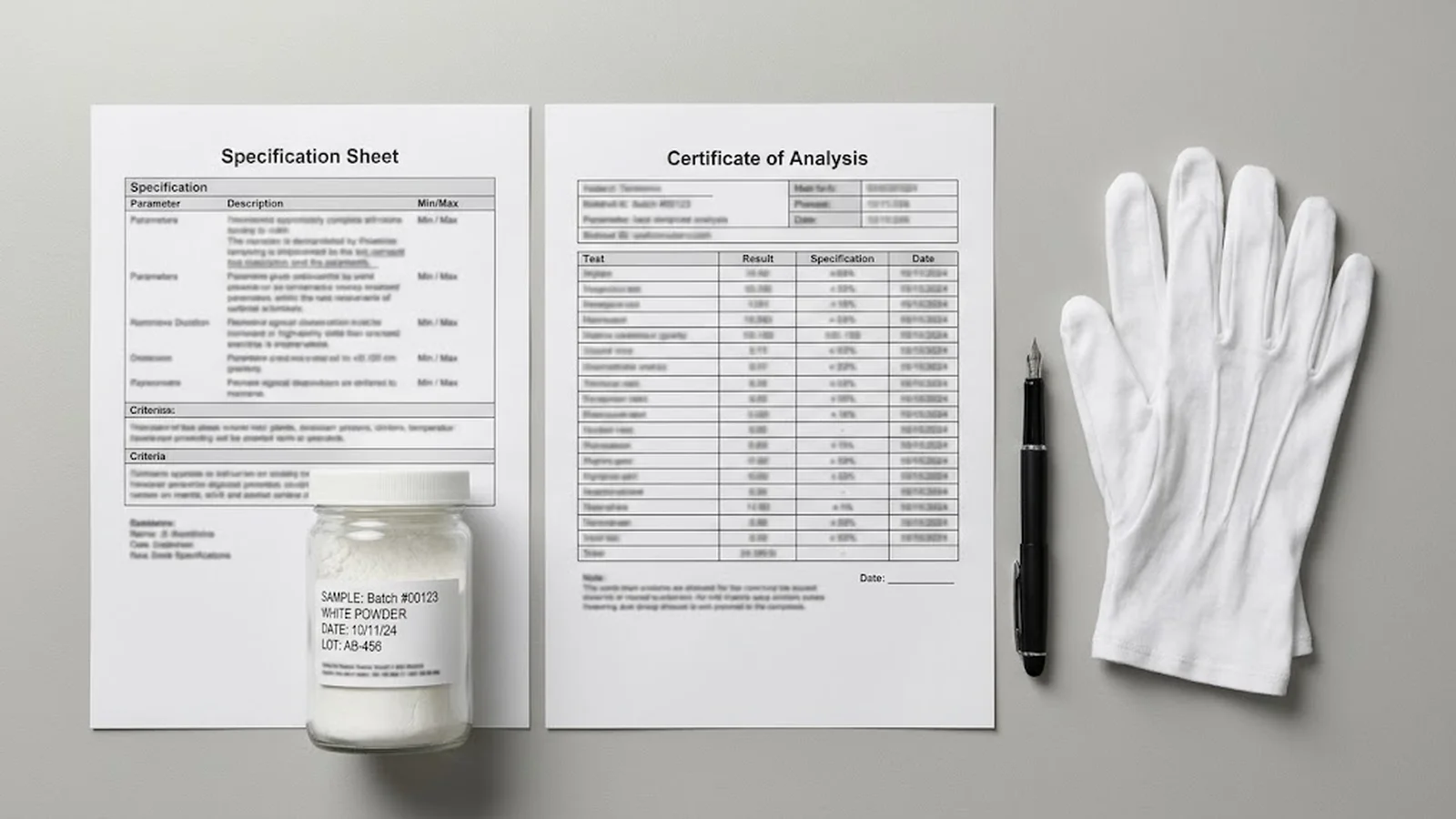
First, the COA must match. Amazon increasingly asks for a COA tied to the specific lot or date code of the inventory behind the listing, not a generic marketing document — and it must come from an ISO/IEC 17025-accredited laboratory or the manufacturer's in-house lab with supporting qualification. A finished-product COA that omits identity, potency, and contaminant testing (heavy metals, microbials) is treated as incomplete.
Second, the supplement policy distinguishes the product type. A PS capsule labeled for "memory support" is a conventional supplement; a product positioned with disease language ("treats ADHD," "prevents cognitive decline") leaves the supplement framework entirely and faces removal regardless of paperwork quality.
The Ingredient Documents That Feed a Compliant Listing
Marketplace compliance is downstream of ingredient compliance. The documents a PS supplier provides map directly onto what Amazon asks the finished-product seller to produce:
| Marketplace requirement | Ingredient document that supports it |
|---|---|
| Product identity and potency on the COA | Lot-specific PS assay (HPLC), fatty acid identity profile |
| Contaminant testing | Heavy metals, microbiological, peroxide value, residual solvents results |
| Allergen and ingredient accuracy | Allergen statement, GMO statement, ingredient specifications |
| Manufacturing in a registered facility | Supplier food facility registration (US FDA) reference |
| Label accuracy | Specification sheet matching the Supplement Facts formulation |
The practical takeaway: ask for the document package before the first production order, and keep it organized per lot. Third-party verification sits mid-chain — for buyers who want the testing layer independently reviewed, the third-party testing checklist for phosphatidylserine covers how to scope and interpret outside lab work.
One caution: a supplier COA on the raw material is not a finished-product COA. The brand or contract manufacturer still needs testing on the finished capsule, gummy or powder — but a well-documented raw material shortens that work substantially.
EU Marketplaces: Notification, Distance Selling, and Responsible Parties
Amazon's EU marketplaces add a regulatory layer the US does not have. A food supplement sold in an EU member state must be notified to that state's competent authority under Directive 2002/46/EC — and each member state notification is separate. Selling from amazon.de, amazon.fr and amazon.it means, in practice, three notification regimes with different languages, portals, and label requirements.
Distance selling raises the bar further: under Regulation (EU) No 1169/2011, all mandatory food information must be available to the consumer before purchase — meaning the listing page itself must carry the designation, ingredient list, allergen declaration, net quantity, and nutrition declaration, consistent with the physical label. Amazon EU has also begun requesting evidence of the responsible food business operator established in the EU, which for non-EU brands means an authorised representative arrangement.
The claims layer is stricter too. Regulation (EC) No 1924/2006 applies to the listing page as much as to the carton, and the EU register of permitted claims is far narrower than the US structure-function space. A listing imported unchanged from the US store is a common and expensive mistake.
Claims Copy: What You Can and Cannot Say in a PS Listing
In the US, structure-function language ("supports memory and focus") is permissible for a supplement with the FDA disclaimer, while disease claims ("treats," "cures," "prevents" a named condition) are prohibited and are the single most common trigger for listing removal. Amazon screens listing titles, bullets, and A+ content with automated and human review; mood, stress, ADHD, dementia, and depression language around PS draws scrutiny quickly.
For EU listings, only authorized health claims from the Article 13 register can appear — and phosphatidylserine has limited authorized claim coverage in the EU, so most compliant PS listings rely on permitted nutrient-function statements or descriptive (non-claim) copy. Translating US copy into German or French word-for-word can convert a permissible US statement into an unauthorized EU claim, so claims need review per market, not just per language.
Both regimes reward the same discipline: keep every benefit statement traceable to a permitted category, keep the disclaimer where required, and keep listing copy consistent with the label and notification file.
Keeping the Listing Compliant Lot After Lot
Compliance is not a one-time gate. Three routines keep a PS listing stable:
- Lot rotation and document retention. Keep a per-lot file: raw-material COA, finished-product COA, and the statements referenced above. When Amazon requests documents, response speed matters — a missing file during a review window can suspend a listing.
- Change control on the formula and supplier. Switching PS grade, source (soy to sunflower), or contract manufacturer changes the document basis of the listing. Update specs, retest, and revise the label before the new lot ships. The US dietary supplement product listing requirements for FDA registration are a related upstream step worth reviewing in the same cycle.
- Listing copy audits. Re-read the live listing each quarter against current policy — including A+ modules and image text, which sellers often forget — and align it with any label change.
Brands that treat marketplace compliance as an extension of supplier quality pass these reviews routinely; brands that treat it as a listing-time paperwork task do not.
الأسئلة الشائعة
Does Amazon require a COA for every lot of a phosphatidylserine supplement?
Amazon's policy requires a COA supporting the product, and enforcement increasingly expects lot-specific documentation for the inventory behind the listing. In practice, keep a COA per production lot from an ISO/IEC 17025-accredited or qualified in-house laboratory, covering identity, potency, and contaminants. A single marketing COA covering "the product" indefinitely is a common cause of document rejection.
Can I use the same documents for amazon.com and Amazon EU?
No. The US side rests on FDA facility registration, Supplement Facts compliance, and finished-product COAs. EU marketplaces additionally rely on member-state food supplement notifications, a responsible food business operator established in the EU, and distance-selling labeling under Regulation 1169/2011 with stricter claims rules. The ingredient documents (COAs, specifications, statements) carry over; the compliance structure does not.
What claims language removes a PS listing fastest?
Disease claims in the US — "treats ADHD," "prevents dementia," "reverses cognitive decline" — and unauthorized health claims in the EU, including translated US structure-function copy. Cognitive-health categories attract automated review, so avoid condition names in titles, bullets, and image text, and keep every benefit statement in the structure-function or permitted-claim space.
Who is responsible for marketplace compliance — the brand or the manufacturer?
Marketplace accountability sits with the seller of record — the brand. The contract manufacturer and ingredient supplier support with documents (COAs, registrations, specifications, statements), but the brand owns the listing, the claims, and the response to Amazon's requests. This is why brands should audit the supplier document package before the first order, not after the first document request.
الخاتمة
Amazon compliance for a phosphatidylserine supplement is decided upstream of the listing: a well-documented ingredient, a tested finished product, a claims-reviewed copy set, and a per-lot filing routine. Sellers who build this chain launch faster and survive document reviews; sellers who improvise at the document request lose the listing window they paid to create.
If you are selecting a raw-material partner for a marketplace-bound PS product, review the sunflower-derived phosphatidylserine و soy-derived phosphatidylserine pages for grade options and the declarations each route carries, and request the full document package with your sample. Compliance paperwork is easiest when it arrives with the powder.
المصادر
- Amazon Seller Central: Dietary Supplements and Supplement Labels Policy
- US FDA: Dietary Supplements
- eCFR: 21 CFR 101.36 — Supplement Facts Labeling
- Regulation (EU) No 1169/2011 on Food Information to Consumers
- Regulation (EC) No 1924/2006 on Nutrition and Health Claims
الفئة المناسبة من المشترين
لمن هذا الدليل
أُعدّ هذا الدليل لفئات المشترين أدناه. افتح ملفك للاطلاع على الدرجات والوثائق والخطوات التالية المناسبة، أو أرسل لنا متطلباتك مباشرةً.
الخطوات التالية الموصى بها
- قم بمراجعة Phosphatidylserine صفحة المنتج.
- قارن Soy PS و Sunflower PS.
- يفحص إثبات التصنيع و الجودة والبحث والتطوير.
اتصل بالمبيعات للحصول على مستندات المنتج
مشاركة تفضيلات المصدر والتطبيق والبلد والكمية السنوية.
اتصل بالمبيعات