

Most phosphatidylserine sourcing decisions are made on assay, price, and documentation. Far fewer are made on whether the powder actually runs on the buyer's press or encapsulator — and that is where programmes lose weeks after the purchase order is signed.
Phosphatidylserine is a phospholipid powder with low bulk density, a pronounced tendency to take up moisture, and surface behaviour that makes it stick to tooling under the wrong conditions. None of those traits are defects; all of them are manageable. What matters for a US or EU buyer is whether the supplier can describe them with numbers and support the description with data — which this guide covers, from material properties to the tableting controls your quality unit should expect.
Why Excipient Compatibility Belongs in Supplier Qualification
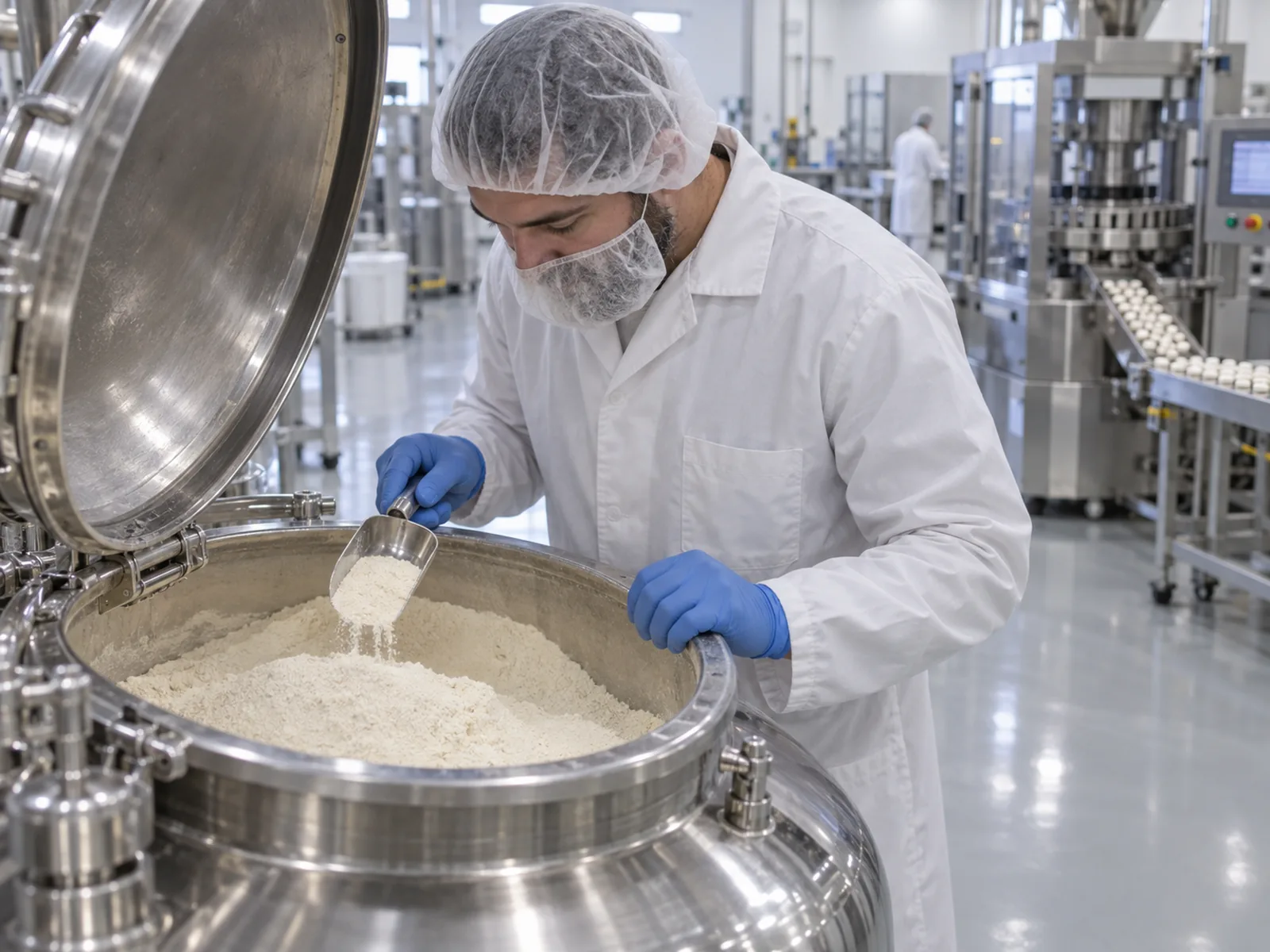
Excipient compatibility is normally treated as an internal formulation problem: the buyer receives the ingredient, runs blends, and discovers the behaviour. That sequence is expensive — poor flow means a glidant change or a granulation step, moisture sensitivity means humidity control and tighter in-process limits, and the wrong lubricant level means a compression redesign.
A better approach is to treat compatibility evidence as part of supplier qualification. Two suppliers offering the same phosphatidylserine assay on the same specification sheet can behave differently on the same press, because assay says nothing about particle-size distribution, bulk and tapped density, loss on drying, or peroxide value. Ask for those parameters and for the compatibility work behind them. Under US dietary supplement GMP expectations (21 CFR الجزء 111), the finished-product manufacturer owns process control — but the ingredient supplier provides the data that makes it possible.
Phosphatidylserine Material Properties That Drive Compatibility Risk
Particle size, density, and flow behaviour
PS powders are typically low in bulk density, and fines content drives flow and dust behaviour. Request particle-size distribution with method, bulk and tapped density, and the calculated compressibility index or Hausner ratio. Poor flow shows up as fill-weight and tablet weight variation before it shows up as a failed assay.
Hygroscopicity and moisture uptake
PS takes up moisture from ambient air, and uptake changes flow, compressibility, and colour. Loss on drying and water activity are the practical controls: a controlled-humidity blending and compression area, sealed intermediate containers, and short exposed hold times matter more than any formulation change.
Oxidative sensitivity of a phospholipid
As a phospholipid, PS is assessed for peroxide value and, where relevant, anisidine value. High-shear blending that warms the mass and prolonged air exposure are the main risk factors. Ask for the peroxide-value specification and its stability basis, then confirm your blending step is not the dominant oxidative stress.
What a Defensible Compatibility Data Package Contains
Study design: binary blends versus full-formula trials
A credible package has two tiers. Binary blends — PS with each candidate excipient at realistic ratios — screen for interactions; full-formula trials then confirm behaviour in the actual matrix. Ask which tier was run and at what ratios. A 1:1 screening blend is a screening result, not a formulation result.
Analytical endpoints worth requesting
Assay by a validated method is the minimum. Beyond it, request peroxide value, loss on drying or water activity, colour, and a chromatographic purity profile where available. For physical performance, blend uniformity and, for tablets, content uniformity, hardness, and friability data are what validation will need.
Stress conditions, time points, and acceptance criteria
Compatibility is measured under stress, not at rest. Look for elevated temperature and humidity conditions, defined time points, and pre-stated acceptance criteria. The stability logic behind such protocols is standardised in ICH Q1A(R2), and excipient expectations are published in the USP–NF. A report with no time points and no pass/fail criteria is a data sheet, not a study.
Common Excipients: What to Expect and What to Verify
Microcrystalline cellulose
MCC is the usual filler-binder for PS tablets: it improves compressibility and dilutes a low-density active into a workable blend. Verify the grade — particle size and moisture level change flow and compaction. Confirm the supplier has trialled PS against the specific MCC grade you intend to use.
Magnesium stearate and other lubricants
Magnesium stearate reduces ejection force and sticking, but over-lubrication weakens tablets and slows disintegration. Because PS already tends to stick, the temptation is to add more. Instead, fix a lubrication range and blend time in development and hold it. Treat any supplier lubrication data as a starting point for your own trial.
Silicon dioxide and other glidants
Colloidal silicon dioxide is the standard answer to poor flow in low-density phospholipid powders and is generally compatible with PS. It addresses flow, not compressibility or moisture uptake.
Fillers, binders, and disintegrants
Dicalcium phosphate, lactose, and mannitol appear in PS formulas depending on the target tablet profile; croscarmellose sodium and related disintegrants handle disintegration. Compatibility questions here are mostly moisture-mediated rather than chemical, so confirm each excipient's own moisture specification.
Tableting and Capsule-Filling Considerations
Direct compression versus granulation
Direct compression is the first choice on cost, and it often works for PS when the grade is selected for flow and the room is humidity-controlled. Granulation — dry granulation in particular — becomes the answer when the dose is high, the blend segregates, or fill-weight variation cannot be controlled. Decide this on trial data, not on preference.
Encapsulation flow and fill-weight uniformity
Capsule filling is a volumetric process, so low bulk density translates into fill-weight variation and, at high doses, capsule-size escalation. Confirm the tapped density of the lot you will receive, then size the capsule and set dosing parameters from that number rather than a nominal specification value.
Tooling, sticking, and picking
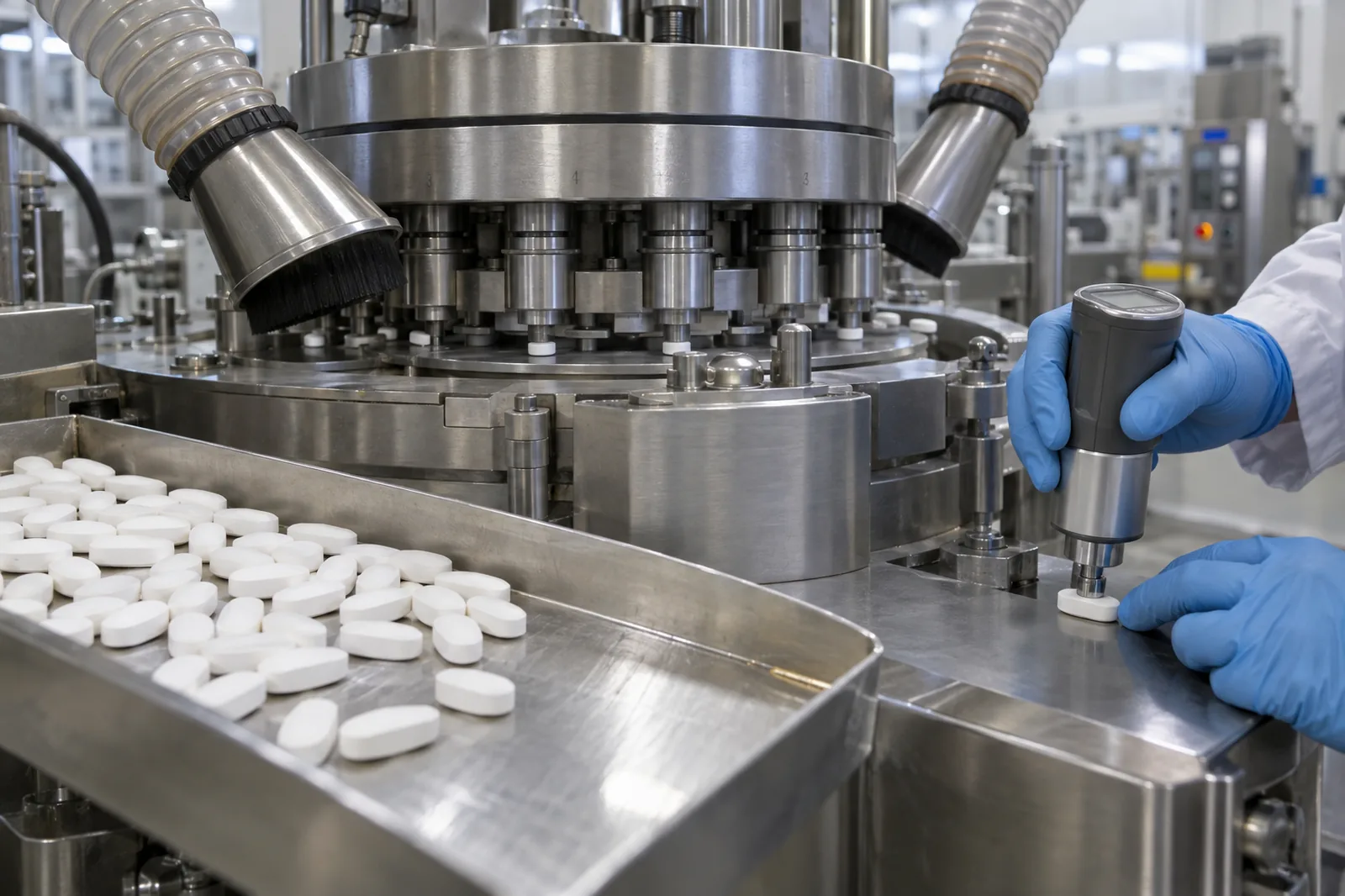
Sticking and picking on punch faces are the most reported PS tableting complaints. Usual causes are excessive moisture, insufficient lubrication, and compression speed generating heat. Polished or coated tooling, controlled humidity, and a modest reduction in press speed usually resolve it. Document the parameter set that works, because it becomes your validation record.
A Buyer's Checklist for Reviewing a PS Technical Data Package
- Request the full specification, not the COA alone — methods, limits, and version date.
- Confirm physical parameters: particle-size distribution, bulk and tapped density, loss on drying or water activity.
- Confirm oxidative parameters: peroxide value, and the stability basis behind the limit.
- Ask for compatibility data and check whether it is binary screening or full-formula.
- Check that stress conditions, time points, and acceptance criteria are stated.
- Confirm excipient grade identity, including lubricant level and blend time.
- Ask for recommended storage, handling, and in-process humidity limits in writing.
- Confirm lot-to-lot control: how parameters are trended, and what triggers a customer notification.
- Verify the quality-system baseline — GMP, ISO, or equivalent audit evidence.
الأسئلة الشائعة
Is phosphatidylserine compatible with magnesium stearate?
Magnesium stearate is widely used in PS tablet formulas and is generally compatible at normal lubrication levels. The practical risk is over-lubrication: excessive levels or long blend times can reduce tablet hardness and slow disintegration. Fix a lubrication range during development and validate it.
Does phosphatidylserine require granulation before tableting?
Not by default. Many PS formulas run by direct compression when the grade is selected for flow and blending and compression are humidity-controlled. Granulation becomes preferable at high active loads, when segregation appears, or when fill-weight variation cannot be controlled.
How hygroscopic is phosphatidylserine powder in practice?
It takes up enough moisture to affect flow, compressibility, and colour if left exposed in a humid room. Control it with a loss-on-drying or water activity limit, a controlled-humidity blending and compression area, sealed intermediate containers, and short exposed hold times.
What should I request from a phosphatidylserine supplier before formulation trials?
The full specification with methods, physical parameters including particle size and density, peroxide value with its stability basis, any excipient compatibility data, recommended storage and handling conditions, and a batch-specific COA for the sample lot.
Can a supplier's compatibility study replace my own?
No. Supplier data is a screening input and a qualification signal. Your own compatibility, blend-uniformity, and stability work remains necessary, both for validation and because the finished-product manufacturer owns process control under US and EU GMP expectations.
الخاتمة
Excipient compatibility is where a phosphatidylserine specification meets reality. Assay and price tell you what you are buying; particle size, density, moisture, and peroxide value tell you how it will behave on your equipment.
The practical test is simple: can the supplier describe its material's behaviour with numbers, and does the data package hold up under audit? If so, formulation work starts from evidence.
المصادر
- U.S. Food and Drug Administration (FDA) — Current Good Manufacturing Practice for Dietary Supplements (21 CFR Part 111): https://www.fda.gov/food/current-good-manufacturing-practice-cgmp-dietary-supplements
- U.S. Food and Drug Administration (FDA) — Dietary Supplements: https://www.fda.gov/food/dietary-supplements
- ICH Q1A(R2) — Stability Testing of New Drug Substances and Products: https://database.ich.org/sites/default/files/Q1A%28R2%29%20Guideline.pdf
- USP — Standards and USP–NF Excipient Monographs: https://www.usp.org/standards
- هيئة سلامة الأغذية الأوروبية (EFSA): https://www.efsa.europa.eu/
- ISO 22000:2018 — Food Safety Management Systems: https://www.iso.org/standard/71726.html
- International Pharmaceutical Excipients Council (IPEC Europe): https://ipec-europe.org/
الخطوات التالية الموصى بها
- قم بمراجعة Phosphatidylserine صفحة المنتج.
- قارن Soy PS و Sunflower PS.
- يفحص إثبات التصنيع و الجودة والبحث والتطوير.
اتصل بالمبيعات للحصول على مستندات المنتج
مشاركة تفضيلات المصدر والتطبيق والبلد والكمية السنوية.
اتصل بالمبيعات