

Outsourcing a phosphatidylserine blend looks like the simplest decision in a supplement supply chain. The formula is fixed, the ingredient is available, and blending is a physical operation with no chemistry in it. Then the first commercial batch arrives with assay results that vary across the drum, or a finished-product allergen test flags soy protein in a product that was supposed to contain sunflower-derived PS with no soy declaration.
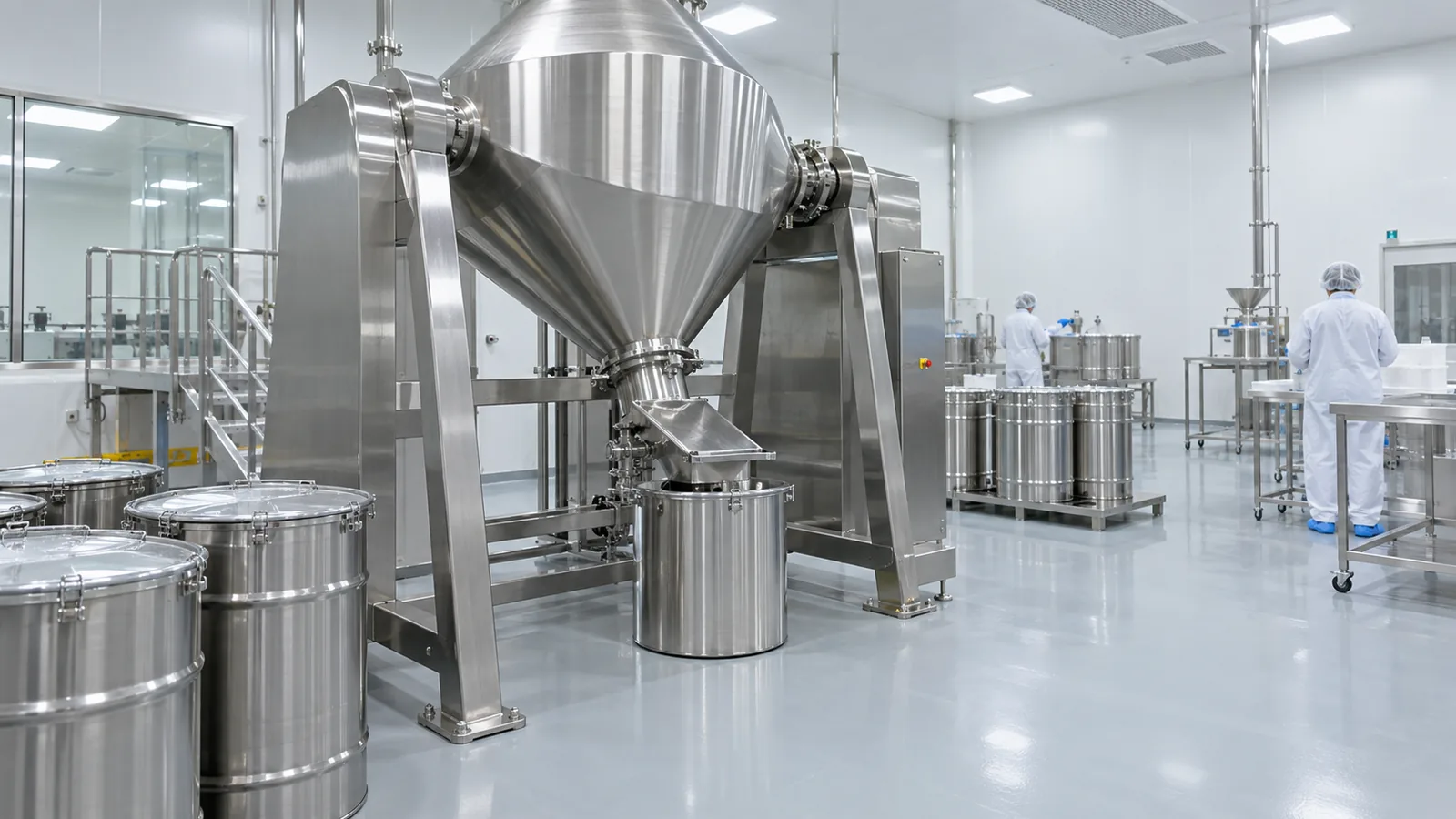
Both failures share a root cause: blending was treated as a commodity service rather than a controlled operation with validated parameters, documented segregation, and statistical release criteria. PS makes this matter more than a robust mineral premix would — it is hygroscopic, oxidatively sensitive, often a minority component, and it responds badly to over-mixing, segregation, and moisture pickup.
This guide sets out what US and EU buyers should verify before awarding blending work: the quality system, allergen-control design, uniformity evidence, equipment fit, scale-up path, and per-batch release documents.
Why Phosphatidylserine Blending Is Not a Commodity Mixing Job
Three properties drive the risk. First, PS is usually a low-inclusion ingredient — a few percent of a blend, sometimes less. Low-inclusion actives are the hardest to distribute uniformly and the easiest to segregate afterwards, because any difference in particle size or density between the active and the bulk excipients expresses itself during discharge, conveying, and vibration.
Second, the powder takes up moisture. Blending in an uncontrolled-humidity room holds the material open to water uptake, affecting flow, compressibility, and later peroxide value and colour. A dry blender is not enough; the room needs humidity control and the process a defined maximum exposed hold time.
Third, PS is oxidative. Long blend times, shear that heats the powder, and headspace oxygen all move peroxide value the wrong way, so blender type, fill level, speed, time, and order of addition belong in a batch record rather than in operator judgement.
GMP and Food Safety Systems to Verify Before Anything Else
Certificates, scope, and the audit question
Ask which quality system the site operates under and whether the certificate covers powder blending and packing of food or supplement ingredients; a certificate for liquid filling or storage only says little about the operation you are qualifying.
Then ask the audit question directly: will the site accept a customer or third-party audit, and what were the findings of the most recent one? A partner that can describe its last findings and corrective actions tells you more than one that only sends a certificate.
Change control, complaints, and recall readiness
Blending introduces variables the ingredient supplier does not control: equipment, room conditions, operator technique, intermediate storage. Ask how a change in any of them is controlled and communicated — a silent blender change or a shifted hold time can change blend behaviour without changing the ingredient at all. Also ask for the complaint and recall procedures and for retention-sample practice, since retained samples of the released blend are what make a later disagreement resolvable.
Allergen Segregation and Cross-Contact Control
Allergen control is a facility design question, not a cleaning question. Ask whether the site handles major allergens — soy, milk, wheat, tree nuts, peanuts, egg, sesame — and how segregation is achieved. Physical separation by room or dedicated equipment is stronger than separation by scheduling, and dedicated utensils, colour-coded tooling, and dedicated packaging lines reduce reliance on cleaning validation.
For phosphatidylserine, source matters. Soy-derived and sunflower-derived PS are different allergen and labelling stories, and a blender handling both must demonstrate that a soy-PS run cannot contaminate a sunflower-PS run. Ask for the allergen matrix, the cleaning procedure with its validation or verification basis, and the protein-swab or equivalent results used to release a line after cleaning. Ask too how in-process material is identified, how allergen-containing intermediates are marked, and how rework is handled — rework is where segregation failures usually start.
Blend Uniformity and Homogeneity Verification
Sampling plan and marker selection
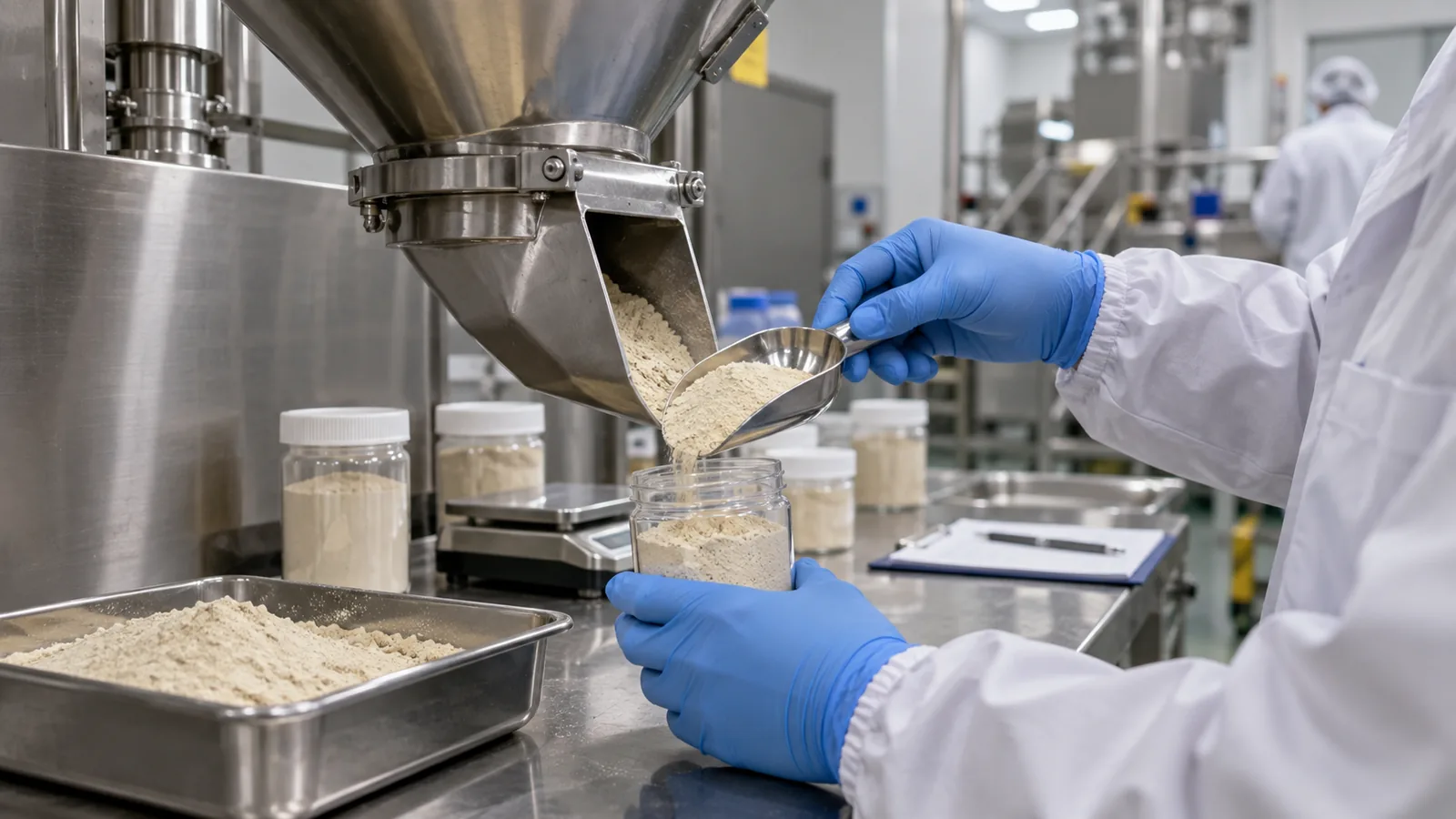
Blend uniformity is proven by sampling, not by assertion. A defensible plan states the number of samples, their locations, the sample size relative to the dosage unit, and the analytical method. Locations should cover the blender geometry — top, middle, bottom, and the discharge region — and must include samples taken after discharge, because that is where segregation shows up.
Choose the marker carefully: for a low-inclusion active the assay method must have adequate precision at that concentration, or method variability will be misread as blend variability.
Acceptance criteria and interpreting variability
Agree the criteria before the study: typically a mean within a stated percentage of target with a relative standard deviation limit across samples. Set the limits from method capability and product risk, not from a round number.
Then interpret the result properly. A trend across sample locations — higher at the top, lower at the bottom, or drifting across the discharge sequence — indicates a mixing or segregation mechanism and should be investigated even if the RSD passes. Passing numbers with a visible trend usually mean the next batch fails.
Equipment Fit and Scale-Up Behaviour
Blender types and where each fits
Diffusive mixers such as V-blenders and double-cone blenders are gentle and suit fragile, segregation-prone powders, but need longer cycles. Convective mixers such as ribbon and paddle blenders run larger volumes faster, with more shear and heat — a concern for phospholipid powders when moisture is present. High-shear intensifier bars help deagglomeration but should be used deliberately and briefly. Ask which blender the partner proposes, why, and at what fill level, since over-filled and under-filled blenders behave differently.
From pilot batch to commercial batch
Scale-up is where blending qualifications fail: a 20 kg pilot in one blender does not predict a 500 kg batch in another without a defined relationship. Ask how the partner scales — geometric similarity, constant tip speed, constant Froude number, or empirically — and require commercial-scale uniformity evidence in the actual blender before routine supply.
The QC Release Document Package
Every released blend should travel with a defined set: a batch production record showing formula, input lot numbers and quantities, equipment used, blending parameters as executed, and yield; uniformity results with the sampling plan and acceptance criteria; assay and quality results for the blend; allergen status and line-cleaning verification where allergens are handled on site; and a signed release record with date. Ask for a redacted sample of the whole package before awarding work — a partner that produces a complete, consistent release file is showing you how it will behave when something goes wrong.
Before awarding, confirm the rest of the package: quality system in scope, audit openness, allergen matrix and cleaning verification, documented change control, humidity and temperature control in the blending area, a stated blender with fill range and cycle time, a uniformity protocol agreed in advance, and retention-sample practice. Then run one paid trial batch through the full process, including packaging and a short stability check, before committing volume.
FAQ
Q: How is blend uniformity tested for a phosphatidylserine premix?
A: By a defined sampling plan — a stated number of samples at specified locations in the blender and across the discharge — assayed by a validated method and judged against a mean and relative standard deviation limit agreed before the study. Post-discharge sampling is essential, because that is where segregation becomes visible.
Q: What RSD limit should I require for a PS premix?
A: Set it from method capability and product risk rather than adopting a default. A low-inclusion active needs an assay method with sufficient precision at that concentration, or method variability will be misread as blend variability. Agree the limit in writing before the study runs.
Q: How should a blending facility control allergen cross-contact for soy versus sunflower PS?
A: Prefer physical segregation — dedicated room, line, or equipment with dedicated tooling — over scheduling and cleaning alone. Where cleaning is the control, require a validated procedure, documented verification such as protein swabbing, and status labelling of in-process material and rework.
Q: Which blender is best for a phosphatidylserine premix?
A: It depends on formula and batch size. Gentle diffusive mixers suit fragile, segregation-prone blends; convective ribbon or paddle mixers run larger volumes faster, with more shear and heat. What matters more than type is that the partner has characterised fill level, cycle time, and order of addition, and can demonstrate uniformity at your commercial batch size.
Q: Can pilot-scale blending results qualify a commercial batch?
A: No, not on their own. Pilot work is screening. Require commercial-scale uniformity confirmation in the actual blender at the intended fill level and cycle time, then verify with a paid trial batch before routine supply.
Conclusion
Selecting a phosphatidylserine blending or premix partner is a quality decision with a commercial shape. The questions that predict success are not about price per kilogram of blended powder; they are whether the site can show you its allergen matrix, its uniformity protocol, its scale-up logic, and a complete release file.
Ask for those four artefacts up front. Partners who have them will answer in a day. Partners who need to invent them will tell you more by hesitating than by any certificate they send.
Sources
- U.S. Food and Drug Administration (FDA) — Current Good Manufacturing Practice for Dietary Supplements (21 CFR Part 111): https://www.fda.gov/food/current-good-manufacturing-practice-cgmp-dietary-supplements
- U.S. Food and Drug Administration (FDA) — Food Allergens: https://www.fda.gov/food/nutrition-food-labeling-and-critical-foods/food-allergies
- European Commission — Regulation (EC) No 852/2004 on the Hygiene of Foodstuffs: https://eur-lex.europa.eu/legal-content/EN/TXT/?uri=CELEX%3A32004R0852
- European Food Safety Authority (EFSA) — Food Allergens: https://www.efsa.europa.eu/en/topics/topic/food-allergies-and-intolerances
- ISO 22000:2018 — Food Safety Management Systems: https://www.iso.org/standard/71726.html
- ISPE — Guidance documents on powder blending and mixing practice: https://ispe.org/publications/guidance-documents
- United States Pharmacopeia (USP) — Standards and analytical method validation: https://www.usp.org/standards
Recommended next steps
- Review the Phosphatidylserine product page.
- Compare Soy PS and Sunflower PS.
- Check manufacturing proof and Quality & R&D.
Contact sales for product documents
Share source preference, application, country, and annual quantity.
Contact Sales