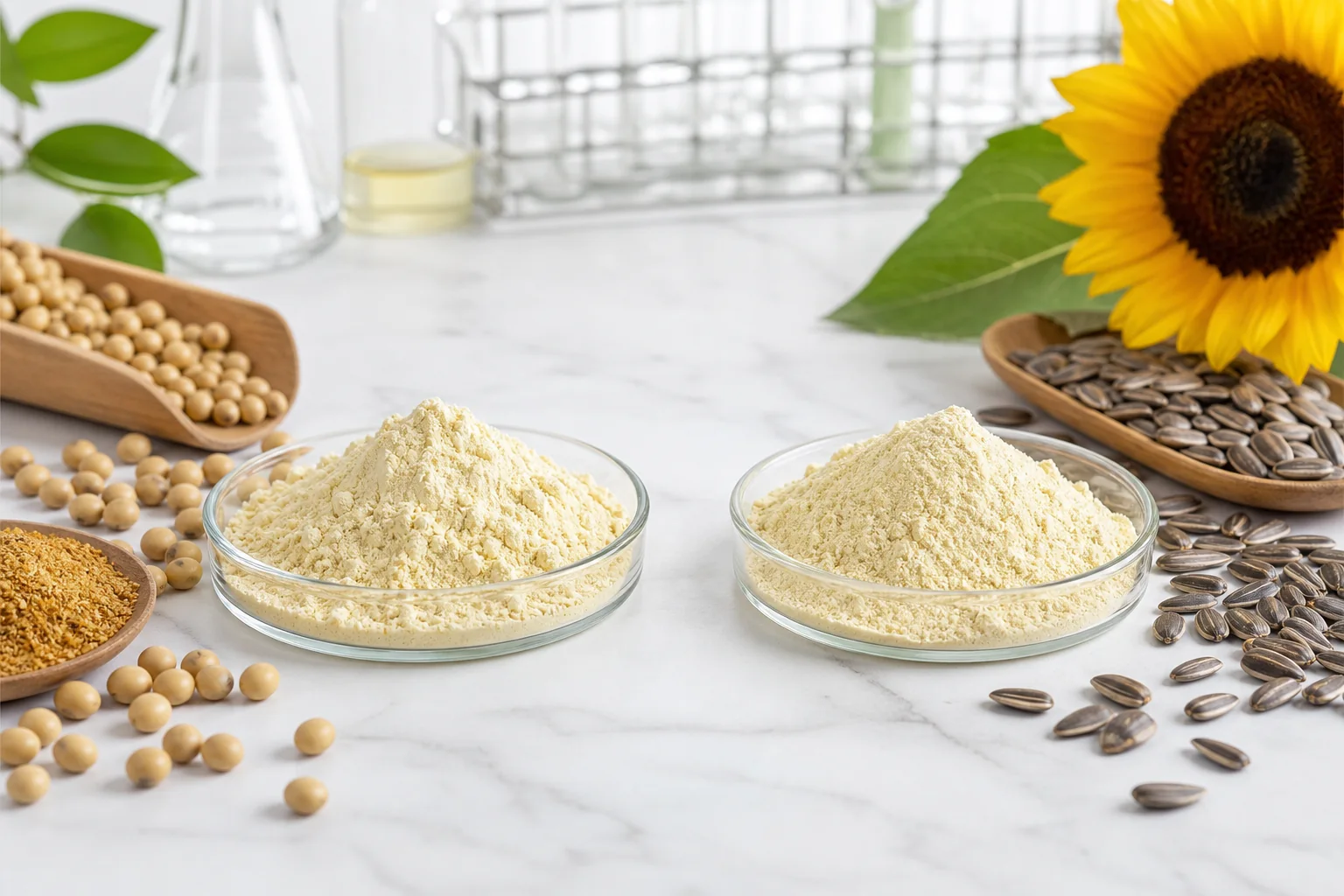
Soy phosphatidylserine and sunflower phosphatidylserine are source-specific PS options. The right route depends on formulation requirements, brand positioning, destination-market review, and the technical documents available for the exact quoted grade.
Quick comparison
| Buyer question | Soy-derived PS | Sunflower-derived PS |
|---|---|---|
| Raw material source | Soy lecithin and L-serine; confirm the quoted product. | Sunflower-source ingredient base; confirm the quoted product. |
| Typical available grades | The supplied English material supports PS 20%; any other soy-source grade must be confirmed. | PS 20% and PS 50% sunflower sample COAs are available for review; final availability must be confirmed. |
| Allergen considerations | Request the current soy allergen and GMO statements for the target market. | Do not infer allergen-free status from sunflower origin; request the current statement. |
| Non-soy positioning | Not the preferred route where a non-soy position is required. | Can support a non-soy position when the documentation matches the quoted product. |
| Vegetarian suitability | Confirm the full formulation, processing aids, label rules, and market requirements for the quoted product. | |
| Halal / Kosher documentation availability | Availability and product scope are available upon request and must be checked for the quoted grade. | |
| Powder characteristics | Confirm appearance, carrier, particle profile, moisture, flow, and storage against the current specification. | |
| Application considerations | Evaluate source acceptance, serving format, flow, moisture, and compatibility in the intended capsule, tablet, powder, dairy, or food process. | Evaluate the same process variables while confirming that the sunflower-source documentation supports the intended positioning. |
| Specification differences | Compare PS assay, carrier, moisture, peroxide value, insoluble matter, microbiology, storage, and test basis in current source-specific documents. | |
| Commercial availability | Confirm current source, grade, sample, and shipment availability through the quotation. | Confirm current source, grade, sample, and shipment availability through the quotation. |
| MOQ considerations | Use the current quotation to confirm MOQ, packaging, palletization, and destination-specific shipment terms. | |
| Documentation requirements | Request the current specification, batch COA, source/allergen statements, packaging, storage, and applicable market files. | |
| Buyer suitability | Often a fit when the project accepts a soy-derived route and the source documents pass market review. | Often a fit when non-soy or sunflower-origin positioning matters and current documents support the claim. |
What is soy-derived PS?
Soy PS is commonly evaluated when a buyer accepts a soy-derived source route and wants to compare source, grade, and document fit for capsules, tablets, powders, dairy formulas, or functional foods. The ingredient name alone does not establish an allergen conclusion or a specific PS concentration. Request the current signed specification, source statement, allergen information, and batch COA.
Review the soy phosphatidylserine product page for the current source description and document-request path.
What is sunflower-derived PS?
Sunflower PS is a source-specific option for buyers who prefer sunflower-origin positioning or need to keep soy and sunflower routes separate during qualification. The site provides PS 20% and PS 50% sunflower sample COAs for preliminary review. Final availability, grade, carrier, and market documents must be confirmed before purchase.
Review the sunflower phosphatidylserine product page and the PS 50% grade page when comparing source and concentration.
Allergen considerations
Soy and sunflower source names are not substitutes for a current allergen statement. Request source, GMO, processing-aid, and destination-market documents for the exact quoted grade, and have the buyer's regulatory team review final label wording.
Formulation considerations
Compare the intended format, target serving, carrier, flow, moisture exposure, oxidation control, and stability plan. Run application and finished-product testing before treating either source as interchangeable.
Specification comparison
Use the PS powder specifications guide to organize assay, appearance, moisture, peroxide value, insoluble matter, microbiology, storage, and test-method questions. The current source-specific specification and batch COA remain controlling.
Documentation buyers should request
- Current product specification tied to the quoted source and grade
- Batch-specific COA and the test basis used for assay and quality indicators
- Source, allergen, and GMO statements where required
- Packaging, storage, MOQ, lead time, and sample information
- Halal, Kosher, or other market-specific files when applicable
Which source should you choose?
Choose soy PS when the project accepts a soy-derived route and the current source and allergen documents fit the target market. Choose sunflower PS when a non-soy position or sunflower-origin route is important and the current specification and source statement support that decision. In either case, qualify the exact product, not only the ingredient name.
When soy PS makes more sense
Soy may be the better starting route when the project accepts soy lecithin-derived material, the buyer already has a qualified soy label position, and the current source-specific documents meet the destination-market review.
When sunflower PS makes more sense
Sunflower may be the better starting route when a non-soy or sunflower-origin position matters and the quoted grade, current source statement, allergen review, and batch evidence support that choice.
Request technical documents
Use the Quality & R&D workflow and request the exact specification, current COA, source/allergen files, packaging, MOQ, and lead time for your project.
Recommended next steps
- Review the Phosphatidylserine product page.
- Compare Soy PS and Sunflower PS.
- Check manufacturing proof and Quality & R&D.
Contact sales for product documents
Share source preference, application, country, and annual quantity.
Contact Sales