
Most phosphatidylserine shipped from Asian production sites to Europe travels two ways: slowly and cheaply by sea, or quickly and expensively by air. Between those poles sits a third option that many ingredient buyers still treat as exotic — container rail freight on the China–Europe corridors. Yet for a mid-value, oxidation-sensitive ingredient like PS, rail can solve a specific and recurring problem: you need product in Europe meaningfully faster than the ocean schedule allows, but the air freight quote would erase the margin on the order.
This guide is for sourcing managers and importers weighing that trade-off. Rail is not automatically better than sea, and it introduces its own risks — summer heat on the steppes, dwell time during gauge changes, and route geopolitics that ocean freight never faces. But for buyers who understand what changes on rail, it is a legitimate tool for replenishment planning, peak-season bridging, and new-product launch timing. The sections below cover how the corridors actually operate, what rail costs relative to the alternatives, and which documents and packaging decisions must be settled before the first container leaves the plant.
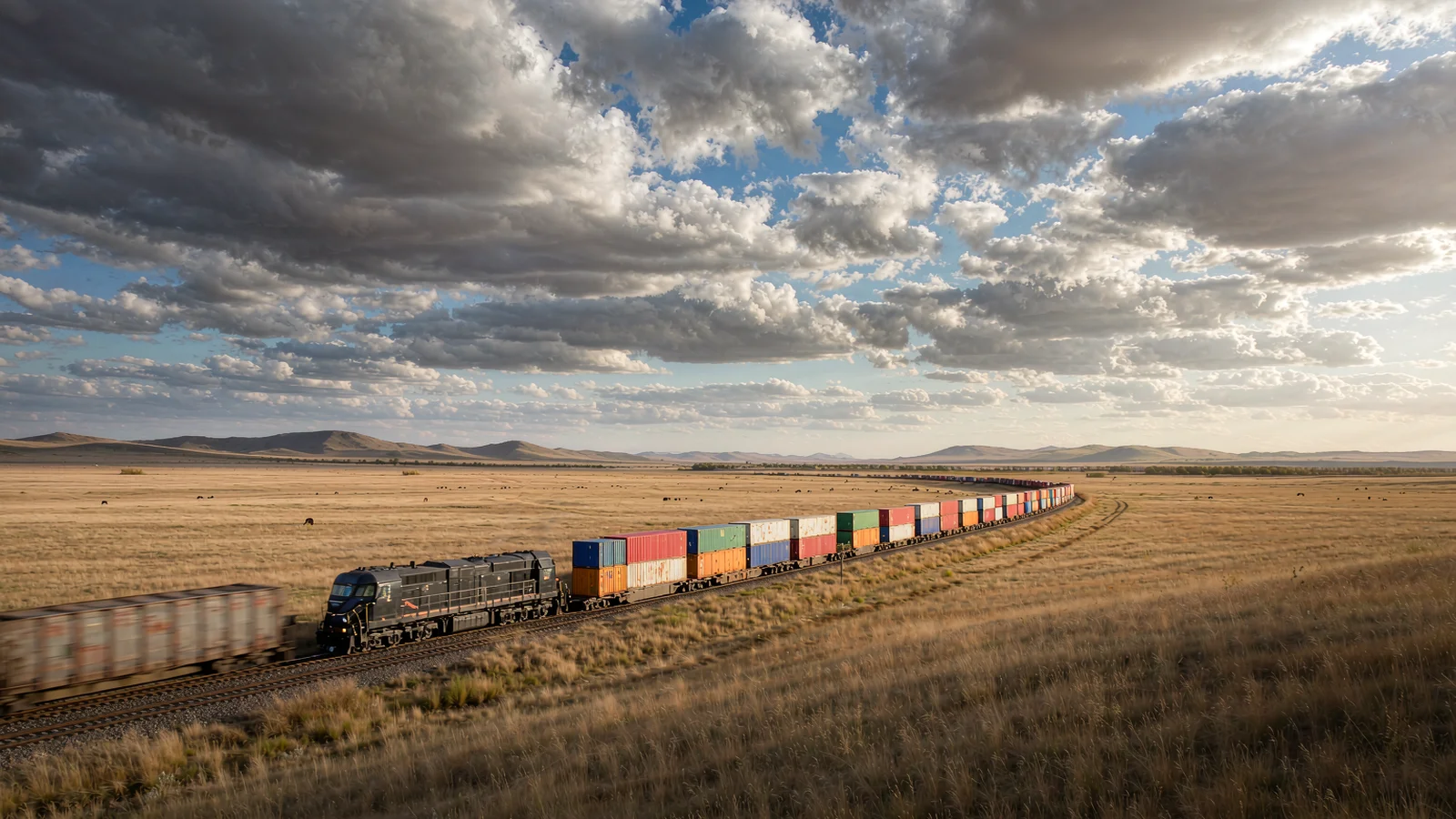
!Freight train containers crossing a vast landscape on the China to Europe rail corridor Buyers preparing this documentation can review our phosphatidylserine programme alongside the grade, source and market detail above.
Where rail sits between sea and air
Rail occupies the middle of the speed–cost curve. A typical ocean shipment from a Chinese port to Rotterdam or Hamburg runs roughly 30–40 port-to-port days in normal conditions, and considerably longer when schedules slip. Air freight delivers in a handful of days but at a per-kilogram cost that is usually an order of magnitude above sea for dense palletized cargo. Rail containers between major Chinese consolidation hubs and European terminals commonly complete the journey in roughly two to three weeks — about half the ocean transit, at a freight cost that typically lands between sea and air, closer to sea than to air.
For phosphatidylserine, that middle position matters because of the product's economics. PS is valuable enough per kilogram that long transit ties up working capital and delays revenue, but not so valuable that air freight is routinely justified for replenishment orders. Rail converts a five-to-six-week total supply chain into a three-to-four-week one without the air freight cost shock — which is exactly the window most buyers need when a promotion, a rebrand, or a demand spike compresses the calendar.
Corridors and realistic transit times
The historical trunk route runs from Chinese consolidation points through Kazakhstan or Mongolia and Russia into Poland, Germany, and onward to Western European terminals. Transit from major Chinese hubs to Duisburg or Małaszewicze — the Polish gateway where containers transfer to European gauge infrastructure — commonly runs around 14–20 days, with European distribution adding a few more. Border crossings and the gauge change are the principal dwell points; a well-booked train clears them quickly, while a poorly scheduled one can add days.
Buyers should also be aware that alternative routings exist that avoid the northern corridor entirely, transiting Central Asia, the Caspian region, and Türkiye or the Caucasus before reaching Europe. These middle and southern corridors are longer — often adding a week or more — and capacity is still maturing, but they have become a meaningful option for shippers who prefer not to route through certain transit territories. When you request a rail quotation, ask the forwarder to state the corridor explicitly; "rail" alone does not tell you which risks you are actually carrying.
Cost position and when the math works
Rail freight rates are volatile and quoted dynamically, but the structural relationship holds: rail typically costs meaningfully more than sea and far less than air. Whether the premium is justified depends on what delay costs you, not just what freight costs. Buyers should model rail against sea on total landed cost — freight, insurance, duties are usually comparable — and then weigh the softer variables: inventory carrying cost for the extra weeks at sea, the risk of a stockout or air-freight rescue at the end of a slow ocean transit, and the cash-flow effect of faster container turnaround.
Two recurring scenarios favor rail. The first is the bridge move: your safety stock is drawn down and a sea shipment will arrive too late, but the order is too large for air. The second is predictable seasonal compression — for example, building European inventory ahead of Q4 — where booking rail a few months out locks in a mid-point cost and a reliable window. For routine baseline replenishment with comfortable lead times, sea still wins on cost.
Temperature and seasonality risk on the rails
This is the section PS buyers should read twice. Rail containers crossing Central Asia in summer pass through regions where ambient temperatures can far exceed what ocean containers experience on a temperate North Asia–Europe loop. Combined with dwell at border crossings, a conventional dry container in July can expose cargo to sustained high temperatures — a genuine concern for an oxidation-sensitive phospholipid whose peroxide value trajectory is the key quality marker.
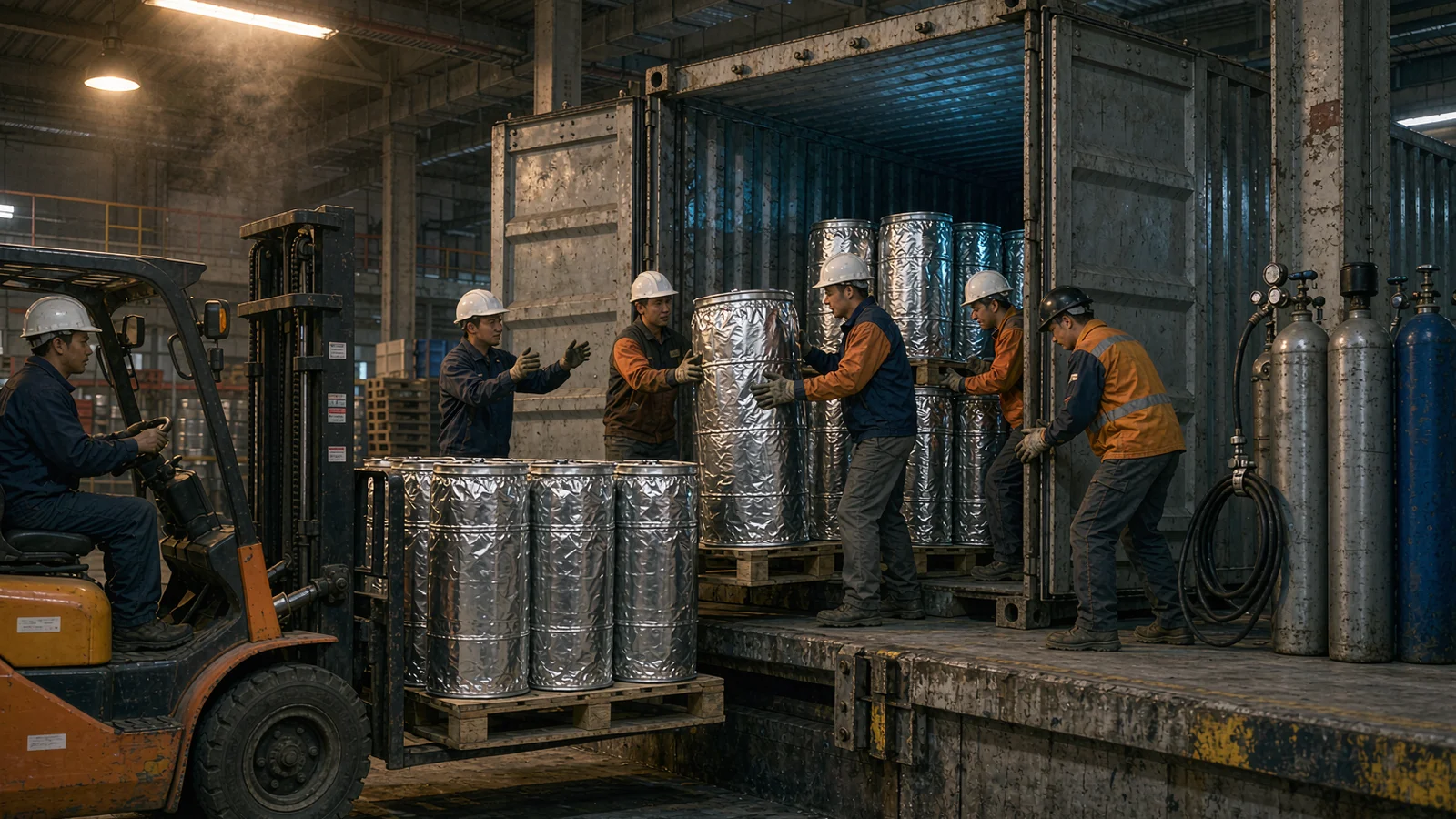
The mitigation is packaging and timing, not necessarily refrigerated equipment, which is rarely available on these corridors. Work with suppliers to ship PS in nitrogen-flushed, foil-lined or well-barriered packaging with robust outer drums, and to minimize summer transit if the product's stability data shows limited thermal headroom. Ask for the supplier's storage-temperature statement and retest period, and check that the total time from production to your European warehouse stays within the assumptions behind the retest date. Booking departures for spring or autumn, when corridor temperatures are milder, is the cheapest quality control available. Buyers reviewing temperature-excursion risk will recognize the logic from the site's earlier guides — on rail, the exposure profile is simply different, and your packaging spec should say so explicitly.
Documents: CIM/SMGS notes, declarations and ISPM 15
Rail documentation differs from ocean paperwork in the carriage contract but overlaps almost everywhere else. International rail moves on the China–Europe corridors use through consignment documentation under the international rail conventions — in practice a CIM/SMGS-style consignment note that accompanies the container across borders, rather than an ocean bill of lading. That difference matters for payment terms: a rail consignment note is not a negotiable ocean bill, so letter-of-credit structures that rely on ocean BLs need adjusting — a point covered in the site's letter-of-credit guide and worth flagging to your bank early.
Everything else will feel familiar. China-side export declarations are prepared at loading; the commercial invoice, packing list, and certificate of origin travel with the shipment; wood packaging must comply with ISPM 15; and European import formalities — EORI-based customs entry, duty payment, and the EU's advance security data requirements — apply at the EU border just as they do for ocean freight. Confirm that your customs broker can lodge entries against a rail arrival at the gateway terminal, and that the consignee details match your import licenses.
Route risk, sanctions screening and insurance
Rail's distinctive risk is geopolitical rather than meteorological. Northern-corridor transits pass through territory where sanctions regimes and transit-policy changes can force rerouting, delay trains, or suspend service on short notice. Prudent buyers therefore do three things. First, ask forwarders how transiting territories are screened for cargo eligibility and get written confirmation that your product and parties are compliant for the stated route. Second, confirm the insurance basis — through-transport cover should reflect the actual rail legs and the liability conventions that apply to them, which differ from the Hague-Visby framework governing ocean bills. Third, build schedule variance into your planning: quote transit ranges, not points, and keep a sea or air fallback priced for critical orders.
Contracting rail shipments: Incoterms and forwarder selection
Rail works under the same Incoterms framework as any other mode. FOB-equivalent and CPT/CIP structures are common: the supplier delivers the container to the consolidation hub, or the forwarder delivers to your European terminal. DAP to your warehouse is workable for buyers who want a single freight number to compare. Whichever term you choose, specify the corridor, the maximum transit window, the temperature-protection requirements, and the document set in the purchase order — the same discipline described in the site's purchase-order specification review guide. Select forwarders who run scheduled China–Europe block trains rather than ad-hoc single wagon loads; schedule integrity and gateway dwell management are where the service quality actually lives.
A decision framework for PS buyers
A simple rule set covers most cases. Use sea for baseline replenishment with lead times above about ten weeks. Use rail when the gap between sea arrival and need falls in the two-to-four-week range and the order is palletized container volume. Use air when the gap is smaller than rail can close, or when launch timing dwarfs freight cost. Re-evaluate seasonally: spring and autumn departures carry less thermal risk and often better schedule reliability. And whichever mode wins, keep the packaging specification — nitrogen flush, barrier liners, sealed drums — constant, because it is your primary defense against oxidation in any mode.
FAQ
How long does rail freight take from China to Europe for ingredient containers?
Plan for roughly two to three weeks hub-to-terminal on the northern corridor, plus European inland delivery. Alternative southern corridors avoiding certain transit territories typically add one to two weeks. Treat quoted transits as ranges and confirm the corridor explicitly with your forwarder.
Is rail freight cheaper than sea freight for phosphatidylserine?
No — rail typically costs more than ocean, though far less than air. The case for rail rests on total cost: shorter transit reduces inventory carrying time, stockout risk, and the chance of an expensive air rescue, which for mid-value ingredients often outweighs the freight premium on urgent replenishment orders.
Does the summer heat on rail routes damage phosphatidylserine quality?
Sustained high temperatures during Central Asian summer transits and border dwell can stress oxidation-sensitive ingredients. Mitigate with nitrogen-flushed, barrier-lined packaging, verified supplier retest periods, and seasonal booking in spring or autumn where possible. Confirm the product's thermal headroom from stability data before committing to a summer rail departure.
Can I use a letter of credit for a rail shipment?
Yes, but the transport document differs. Rail uses a consignment note under the international rail conventions rather than a negotiable ocean bill of lading, so LC terms must be drafted around rail documents. Flag this to your bank and align the LC's document requirements before booking, as covered in our letter-of-credit guide.
Conclusion
Rail freight will not replace ocean for baseline phosphatidylserine supply, and it should not — sea remains the cost backbone of ingredient logistics. But for the recurring middle problem of ingredient buying, where sea is too slow and air too expensive, the China–Europe corridors offer a credible third path. The buyers who use rail well do three things: they book scheduled block-train services with the corridor stated in writing, they adapt payment and insurance structures to rail's document set, and they treat summer heat as a packaging and scheduling problem to be engineered around. Put those three disciplines into your next RFQ and rail becomes a predictable tool rather than a gamble. When you are ready to move from checklist to quotation, contact our team with the grade, source and document set described above.
Sources
- OTIF — Intergovernmental Organisation for International Carriage by Rail (COTIF/CIM framework) — https://www.otif.org
- International Union of Railways (UIC) — https://uic.org
- RailFreight.com — China–Europe rail corridor news and transit data — https://www.railfreight.com
- European Commission, Taxation and Customs Union (import formalities, ICS2) — https://taxation-customs.ec.europa.eu
- IPPC — ISPM 15 wood packaging standard — https://www.ippc.int
- International Chamber of Commerce — Incoterms 2020 — https://iccwbo.org
Buyer fit
Who this guide is for
This guide is written for the buyer profiles below. Open your profile for the matching grades, documents and next steps, or tell us your requirements directly.
Recommended next steps
- Review the Phosphatidylserine product page.
- Compare Soy PS and Sunflower PS.
- Check manufacturing proof and Quality & R&D.
Contact sales for product documents
Share source preference, application, country, and annual quantity.
Contact Sales