

Phosphatidylserine (PS) sits in a demanding spot on a raw-material buyer's risk map: a premium-priced functional phospholipid whose activity and sensory quality depend on a molecule intrinsically prone to oxidation. Unlike mineral salts or crystalline actives, PS powder carries polyunsaturated fatty acyl chains that react with oxygen throughout its life — in production, transit, warehouse, and the finished product on the shelf. For B2B buyers in the US and EU, the question is not whether oxidation occurs, but whether your specification, testing program, and contract terms will detect it before it reaches a customer. This guide covers the test panel buyers should require, trend-data acceptance rules, and the procurement levers that turn lab findings into enforceable controls.
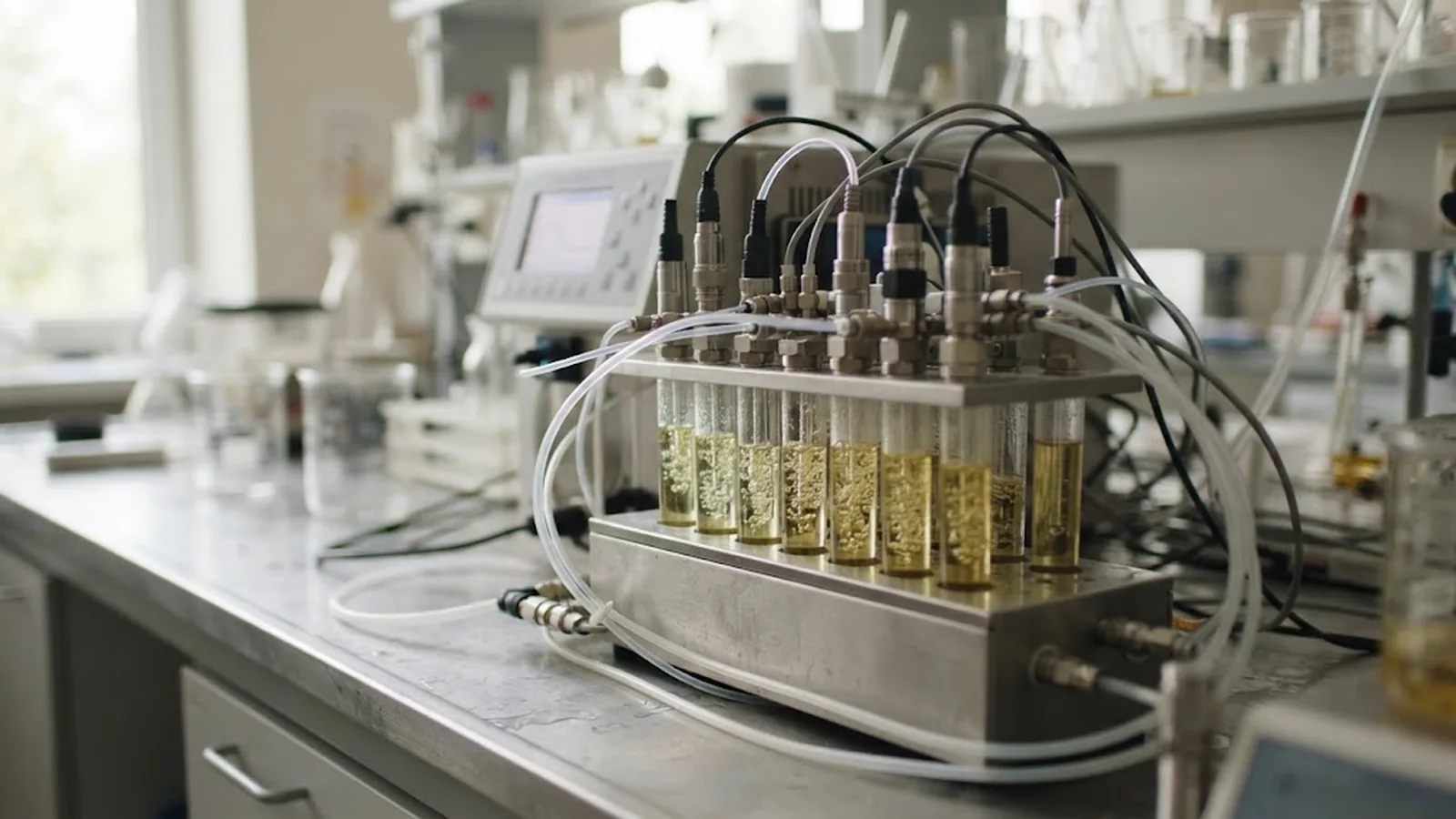
!QA laboratory with analyst examining lipid oxidation test results for phosphatidylserine powder samples Where supplier qualification is the next step, our manufacturing overview documents the facility, process controls and batch records behind each lot.

Why Phosphatidylserine Is Unusually Oxidation-Sensitive
Commercial PS is made by enzymatic transphosphatidylation from soy or sunflower lecithin and retains much of the parent's fatty acid profile: predominantly linoleic acid and, in soy-derived material, a meaningful share of linolenic acid. Every double bond in those chains is a site where atmospheric oxygen can attack, so PS oxidizes orders of magnitude faster than saturated fats.
Oxidation proceeds in two stages. Hydroperoxides form first; peroxide value (PV) captures this early, "current" oxidation. They then decompose into aldehydes and ketones — the compounds behind painty, cardboard off-notes; the p-anisidine value (AnV) and headspace volatiles capture this "history." A material can show a deceptively low PV simply because its hydroperoxides have already broken down — which is why buyers who specify PV alone systematically miss degraded lots.
Hydrolysis compounds the picture: residual moisture and heat raise free fatty acids and change flow and emulsification behavior. Because oxidation is cumulative and irreversible, the specification must measure current oxidation, past oxidation, and the conditions that accelerate it.
Building the Oxidative Stability Panel into Your PS Specification
The table below shows the panel experienced buyers assemble for bulk PS powder, with common methods and market-typical limits. Validate limits against each supplier's process capability and your finished-product needs; treat them as negotiation anchors, not universal standards.
| Parameter | Reference method | Typical acceptance limit | What it tells you |
|---|---|---|---|
| Peroxide value (PV) | AOCS Cd 8b-90 / USP <401> | ≤ 5.0 meq/kg (tight programs ≤ 3.0) | Primary hydroperoxides; early oxidation |
| p-Anisidine value (AnV) | AOCS Cd 18-90 | ≤ 10 | Secondary aldehydes; oxidation history |
| TOTOX | Calculated: 2 × PV + AnV | ≤ 20 | Combined index; common EU buyer requirement |
| Headspace propanal/hexanal | GC-MS (contract lab) | ≤ 0.3 mg/kg, agreed per project | Volatile marker correlating with odor |
| Free fatty acids (FFA) | AOCS Ca 5a-40 | ≤ 1.5% | Hydrolytic rancidity parallel |
| Moisture / water activity | Karl Fischer / Aw meter | ≤ 2.5% / Aw ≤ 0.25 | Driver of hydrolysis and oxidation rate |
| OSI induction period | AOCS Cd 12b-92 (Rancimat) | ≥ 4 h at 110 °C, comparative use | Relative stability screen across lots |
Three drafting notes matter. Define methods and units explicitly — PV in meq/kg versus mmol/kg differs by a factor of two. Require the AnV line even when the supplier's standard COA omits it; it is the most informative history marker for phospholipids. And specify composite sampling from the top, middle, and bottom of the drum, because oxidation is not uniform within a container.
Why One COA Number Is Not Enough: Trend Data Across Lots
A single lot that passes every limit can still sit on a deteriorating trend. If a supplier's PV runs 1.0–1.5 meq/kg for a year and then posts 4.8, that is formally compliant but statistically a five-sigma excursion that usually signals a process change — a new oil source, a drier running hot, a packaging substitution. Buyers who read lot-by-lot numbers without trend context discover the problem three lots later, in consumer complaints.
The fix is trend-based acceptance in the quality agreement: no single lot above the limit; a three-lot rolling mean below 80% of each oxidation limit; any lot above 70% of a limit triggers a documented investigation before release; and a 12-month rolling chart for PV, AnV, FFA, and moisture with each quarterly review. A retained-sample comparison on request is the fastest way to separate a genuine oxidative shift from a lab-to-lab artifact.
Accelerated and Real-Time Stability Studies for PS Powder
Shelf-life claims should rest on a stability study on the finished, packaged material — not the bulk stage. A defensible protocol tests samples at 25 °C/60% RH (real-time) and 40 °C/75% RH (accelerated) at 0, 3, 6, 9, and 12 months, measuring PV, AnV, FFA, moisture, and water activity at each pull, in the same barrier liner you will actually receive.
During qualification, request the protocol and the latest summary report, not just the label claim. Confirm interim time points exist — a 24-month-only endpoint says nothing about month 9 — and ask whether retained samples are re-tested at retest expiry, which determines how confidently you can hold inventory past the printed date.
Contracting Levers: Turning Stability into a Procurement Control Point
Laboratory findings only protect you when they are enforceable. Convert the science into purchase-order and quality-agreement language:
- Write the full panel and numeric limits into the purchase-order specification, not merely "COA to be provided."
- Fix test methods and units for every parameter to preempt lab-to-lab disputes.
- Require AnV and TOTOX on every lot COA, even if the supplier's template omits them; agree who bears incremental cost.
- Make trend-data reporting a recurring quality-agreement deliverable tied to the annual review.
- Specify packaging performance: moisture-barrier liner, defined headspace control, resealable inner bag.
- Reserve the right to confirm oxidation parameters at an independent lab on arrival.
- Define disposition rules for out-of-trend but in-spec lots before the situation arises.
Suppliers with mature lipid handling accept these routinely; resistance itself is a signal about process confidence.
US and EU Buyer Perspectives on Oxidation Evidence
In the US, PS is typically marketed under a self-determined GRAS position or a filed GRAS notice; verify the identity and use level your notice covers. Oxidation evidence supports both the importer's obligation that ingredients meet specification on arrival and substantiation discipline for structure/function claims — degraded material undermines the very cognitive-endpoint studies a label may cite.
In the EU, oxidation control ties into novel-food conditions of use and HACCP obligations for chemical and sensory stability. Both regions converge on one point: importers hold documentary responsibility for what they place on the market, and a complete oxidation panel with trend data is the strongest evidence a buyer can hold when an auditor asks how quality was verified.
FAQ
Q: What is a realistic TOTOX limit for bulk phosphatidylserine powder?
A TOTOX ≤ 20 is a common commercial benchmark for phospholipid powders, with disciplined programs targeting ≤ 15. The trend matters more than the number: a supplier holding TOTOX between 6 and 10 across twelve months beats one oscillating between 5 and 19. Set limits using the supplier's actual historical data.
Q: Can I rely on the supplier's COA peroxide value alone?
No. PV measures only early-stage oxidation and can read low on material whose hydroperoxides have already decomposed into aldehydes. Pair PV with anisidine value and ideally a headspace volatile marker. Relying on PV alone invites the classic failure: a compliant COA on arrival, then rapid off-note development months later.
Q: How often should incoming PS lots be tested in-house?
A tiered approach works well: full panel on the first three lots from a new supplier, then PV, moisture, and a sensory check on every lot, with the complete panel quarterly or whenever trend rules trip. Reserve the contractual right to run the full panel at any time — and use it when statistical flags appear.
Conclusion
Oxidative stability is the defining quality risk of bulk PS — and one of the most controllable. Buyers who specify the complete panel with defined methods and units, monitor trends rather than single numbers, and anchor these requirements in purchase orders and quality agreements convert a chemistry problem into a routine procurement control. The incremental testing cost is trivial next to a rejected container or a consumer complaint file. The specification you write is the cheapest insurance that PS integrity survives from the supplier's reactor to your customer's label. When you are ready to move from checklist to quotation, contact our team with the grade, source and document set described above.
Sources
- FDA — GRAS Notice Inventory
- EFSA Journal — scientific opinions on food ingredients
- NIH Office of Dietary Supplements
- AOCS — Official Methods of Analysis
- PubMed — peer-reviewed literature on lipid oxidation measurement
Buyer fit
Who this guide is for
This guide is written for the buyer profiles below. Open your profile for the matching grades, documents and next steps, or tell us your requirements directly.
Recommended next steps
- Review the Phosphatidylserine product page.
- Compare Soy PS and Sunflower PS.
- Check manufacturing proof and Quality & R&D.
Contact sales for product documents
Share source preference, application, country, and annual quantity.
Contact Sales