A phosphatidylserine sample that performs beautifully in a 20 kg pilot tells you almost nothing about how 500 kg of the same powder will behave on a commercial blender, a capsule filler, or a gabling line. PS is a phospholipid powder with real processing personality: it is compressible but cohesive, sensitive to heat and shear, prone to flow changes with humidity, and its assay must be built into batch calculations with the correct basis. Scale-up failures between the sample stage and commercial bulk rarely come from the ingredient being "bad" — they come from unstaged expectations: skipping a pilot at intermediate scale, treating the first commercial lot as routine production, and not scaling the documentation alongside the batch size. This guide lays out the sample-to-bulk pathway for PS finished products in OEM programs: what each stage proves, what parameters to watch, what documents the contract manufacturer must produce at each gate, and how to avoid the classic failure points that turn a promising launch into a delayed one.
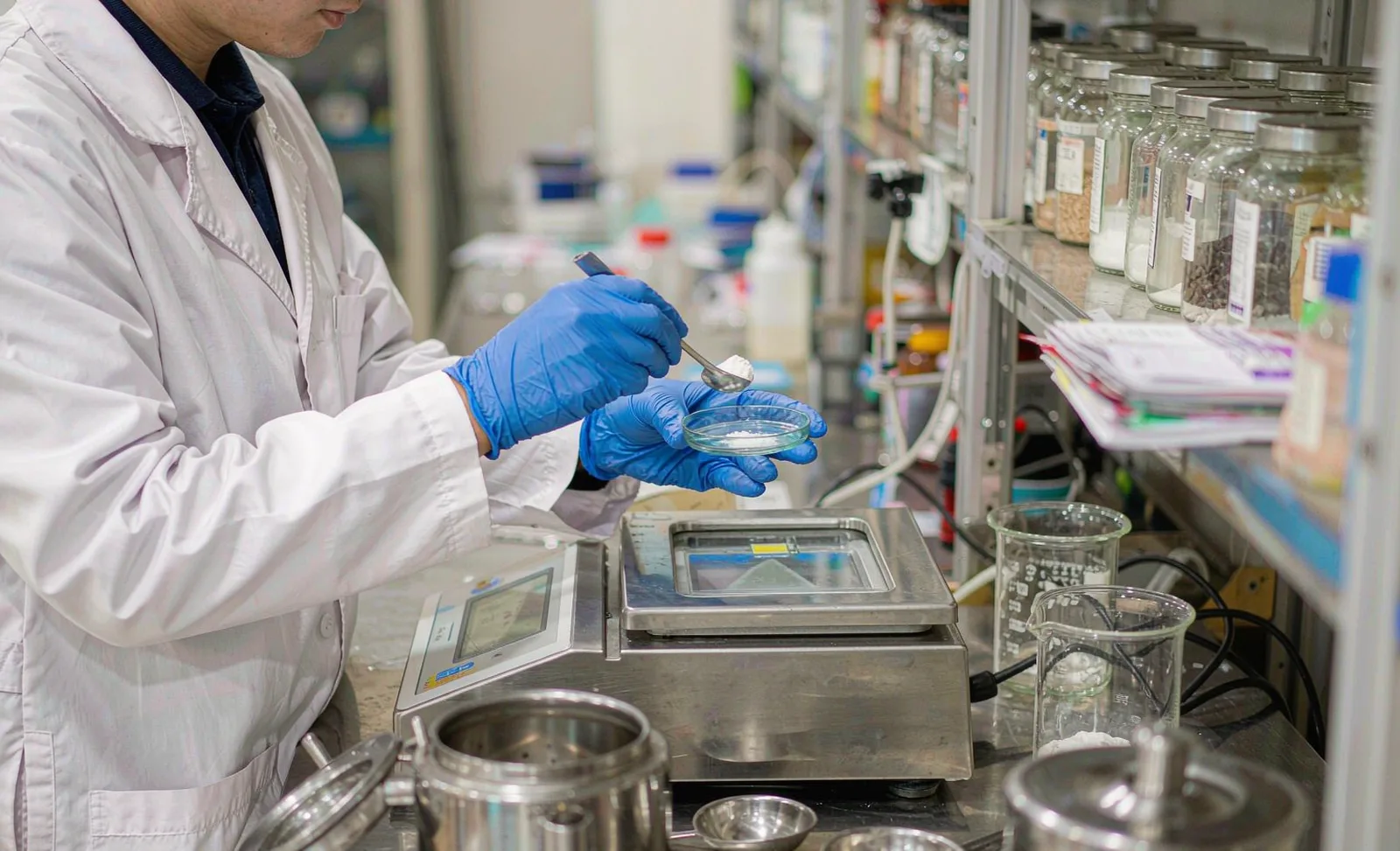
!Laboratory technician preparing phosphatidylserine powder samples in a formulation lab For the specification detail behind these documents, see our quality and R&D overview, including test methods and release criteria.
Stage 0: What the Sample Stage Actually Proves — and What It Does Not
A lab or bench sample (often 0.5–5 kg of blended material, or a few hundred capsules) answers formulation questions: taste, dispersibility, capsule fill weight feasibility, basic blend feasibility with your excipient system, and preliminary assay of the blend. It does not answer scale questions: whether a 1,500-liter ribbon blender will achieve uniformity with this particle-size combination, whether the PS powder will flood or starve the feeder on a high-speed capsule filler, or whether drying temperatures in a fluid bed will push peroxide value upward. Write the sample stage's conclusions down as a bounded claim list ("1 kg scale blend uniformity RSD < 5% with this excipient ratio") rather than a general approval. This habit prevents the most common scale-up mistake: treating an R&D sample pass as an approval of the commercial process.
Stage 1: Pilot Batch at Intermediate Scale
The pilot batch — typically 10–20% of commercial scale, or at minimum the smallest batch your contract manufacturer's equipment can run meaningfully — is where ingredient personality meets real equipment. For PS products, the pilot should verify:
- Blend uniformity — sample the blend at defined time points and locations; PS at low inclusion rates (often 2–10% of a blend) makes uniformity genuinely challenging. Establish the mixing end-point with data, not a fixed clock time.
- Flow and weight control — for capsules and tablets, record bulk/tapped density, angle of repose if used, filler weight variation, and, for tablets, compression force windows and ejection behavior. PS's phospholipid nature can behave like a built-in lubricant at some levels and a friction problem at others.
- Thermal and shear exposure — confirm that processing temperatures and residence times (drying, conching for gummies, high-shear granulation) keep peroxide value and color within specification. Oxidation is PS's most realistic process risk.
- Moisture pickup — PS powders are hygroscopic to a degree; record humidity conditions during the pilot and whether open-handling steps need environmental control at scale.
Pilot output is a written process description with real parameter ranges — this becomes the master batch record's backbone.
Stage 2: Process Qualification and the First-Article Lot
The first commercial-scale lot should be planned as a first-article / process-qualification batch, not a saleable production run. Its purpose is to demonstrate that the transferred process, at full scale, with full-rate equipment, delivers the finished specification. Practical requirements:
- Enhanced in-process sampling — blend uniformity at the commercial mixer scale, weight/fill variation over time, hardness and friability profiles for tablets, and moisture through any drying step.
- Full finished-goods release testing plus assay verification against the label-claim calculation built from the actual PS lot's assay and its correct basis (as-is versus anhydrous; total phospholipid versus PS fraction).
- Stability placement — the first-article lot, not a later lot, should seed the finished-product stability program, because its exposure represents the validated process.
- Documented deviation review — any parameter that required operator intervention or missed its target range is either fixed and re-demonstrated or formally justified.
FDA's process-validation guidance (Process Validation: General Principles and Practices) frames this as stages of process design, qualification, and continued verification — the same staged logic applies to dietary supplements even when a formal Stage 3 statistical program is not practical for low-volume SKUs. Align the contract manufacturer's approach with your quality agreement: define what "qualified process" means for this product before the first-article lot runs.
Stage 3: What Must Scale With the Batch — Documents and Calculations
Scale-up multiplies paperwork as surely as it multiplies powder. Items that must be regenerated at each stage, not copy-pasted:
- Master batch record with commercial-scale equipment, parameter ranges, and in-process checkpoints.
- Batch calculations using the actual PS assay of the commercial lot, including overage policy — decide once whether the label claim is met at end of shelf life and document the overage logic.
- Cleaning validation bridge — PS is a lipid-rich residue; confirm the CM's cleaning verification covers it (visual plus assay or TOC swabs) for shared equipment.
- Specification alignment — the finished-goods spec used for sample evaluation must be identical to the commercial release spec; silent edits here create retrospective compliance problems.
- Traceability file — one-step-back/one-step-forward traceability for the PS lot, the excipients, and packaging components, ready for both US recall-simulation drills and EU traceability expectations.
Managing PS-Specific Scale-Up Risks
Three ingredient-specific risks deserve their own controls. Oxidation during processing: cap open-handling time, avoid high-temperature drying, and verify peroxide value at the blend stage as well as on the incoming raw material. Segregation in transport and storage within the plant: low-inclusion PS powders can demix in conveying; define minimum transfer distances and verify uniformity at the point of fill, not only in the mixer. Assay method portability: confirm the HPLC method used at the CM matches the method behind the PS supplier's COA, or run a method-agreement comparison once during qualification. Each of these has sunk real launches; each costs one pilot-batch data set to control.
Sequencing and Timeline: A Realistic Sample-to-Bulk Plan
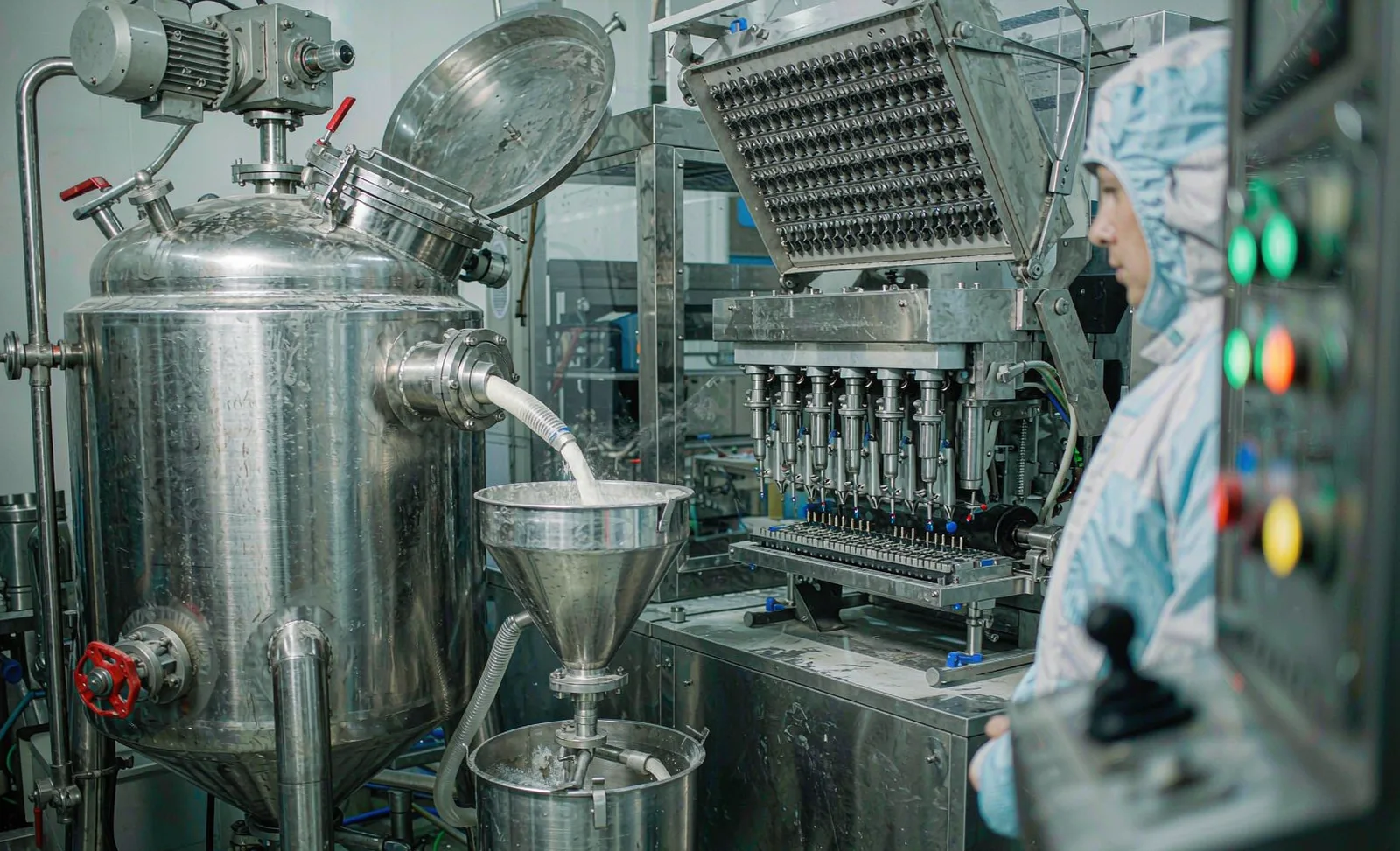
A disciplined pathway for a PS capsule or powder product looks like this: sample evaluation and formula lock (2–4 weeks), pilot batch and analysis (2–4 weeks including review), first-article commercial lot and enhanced testing (3–6 weeks including release testing), and stability placement with initial time-point data before full commercial launch (another 4–8 weeks for accelerated early reads). Total: roughly a quarter from locked formula to launch-ready, with each gate's documentation completed before the next begins. Programs that compress this by skipping the pilot almost always pay the time back — with interest — in first-article deviations, blend reworks, or a stalled release test. For EU-bound products, remember the finished-product documentation and labeling must also be finalized before commercial distribution; ISO 22000-based food-safety systems (ISO 22000:2018) provide a recognized framework for the CM-side controls your customers and auditors will ask about.
FAQ
Q1: Why can't I skip the pilot batch if the sample already passed?
A sample proves the formula; a pilot proves the process on real equipment at a scale where mixing time, heat, and flow behavior resemble production. Skipping the pilot moves all those unknowns into your first commercial lot, where a failure costs the most time and money.
Q2: What blend uniformity target should I set for a low-inclusion PS product?
Common practice is relative standard deviation below 5% across a stratified sampling plan, but the right target depends on your inclusion rate and analytical method variance. Define the sampling locations, number of samples, and acceptance criterion in the pilot protocol — not after the data comes back.
Q3: Should the first commercial batch be sold or held as a qualification batch?
Plan it as a first-article/process-qualification batch with enhanced sampling. If everything passes and stability placement is done, the lot can usually still be released for sale — but it must be produced and judged as a qualification lot, with wider in-process data than routine production.
Q4: Does PS need special cleaning validation at the contract manufacturer?
Yes — phospholipid residues are lipid-rich and can be harder to remove and detect than typical powder residues. Confirm the CM's cleaning verification includes the PS-containing products, with appropriate swab methods or TOC limits, especially on shared blenders, dryers, and fillers.
Q5: How much overage should I build into a PS formulation?
Overage is a quality-policy decision, not a default. Set it from a documented calculation: label claim target, assay variance of the raw material, process and analytical loss, and shelf-life stability data. Many brands target the label claim at end of shelf life with a modest overage justified by stability results rather than a fixed industry percentage.
Conclusion
Sample-to-bulk scale-up for phosphatidylserine products is a staged proof problem: the sample proves the formula, the pilot proves the process, and the first-article lot proves the system at commercial scale — with documents scaling at every step. Brands that define each gate's deliverables before starting, watch PS-specific risks (oxidation, segregation, assay basis), and resist the temptation to skip the pilot reach commercial production with releasable lots and a clean audit trail. Those that compress the pathway usually donate the saved weeks back, plus interest, in deviations and rework. When you are ready to move from checklist to quotation, contact our team with the grade, source and document set described above.
Sources
- FDA — Process Validation: General Principles and Practices (Guidance for Industry): https://www.fda.gov/media/71071/download
- FDA — Dietary Supplements: Current Good Manufacturing Practice overview: https://www.fda.gov/food/dietary-supplements
- ISO 22000:2018 Food Safety Management Systems: https://www.iso.org/standard/71726.html
- USP — Dietary Supplements Compendial Standards: https://www.usp.org/standards
- ICH Q1A(R2) Stability Testing of New Drug Substances and Products (stability design reference): https://database.ich.org/sites/default/files/Q1A%28R2%29%20Guideline.pdf
Buyer fit
Who this guide is for
This guide is written for the buyer profiles below. Open your profile for the matching grades, documents and next steps, or tell us your requirements directly.
Recommended next steps
- Review the Phosphatidylserine product page.
- Compare Soy PS and Sunflower PS.
- Check manufacturing proof and Quality & R&D.
Contact sales for product documents
Share source preference, application, country, and annual quantity.
Contact Sales