Few ingredient choices cascade through a supplement program the way the phosphatidylserine (PS) origin decision does. Pick soy-derived PS and you inherit a major-allergen declaration on every label, exposure to soybean price cycles, and a GMO-adjacent conversation with retail partners. Pick sunflower-derived PS and you typically avoid the allergen statement, but you pay a premium and depend on a more concentrated supply base. Neither is universally better — the right answer depends on your market, label claims, margin structure, and risk tolerance. This guide breaks the decision down the way a sourcing team should: origin and extraction route, allergen labeling in the US and EU, spec differences, supply chain realities, and the price mechanics behind quoted per-kilogram numbers.
Raw Material Origin and Extraction Route
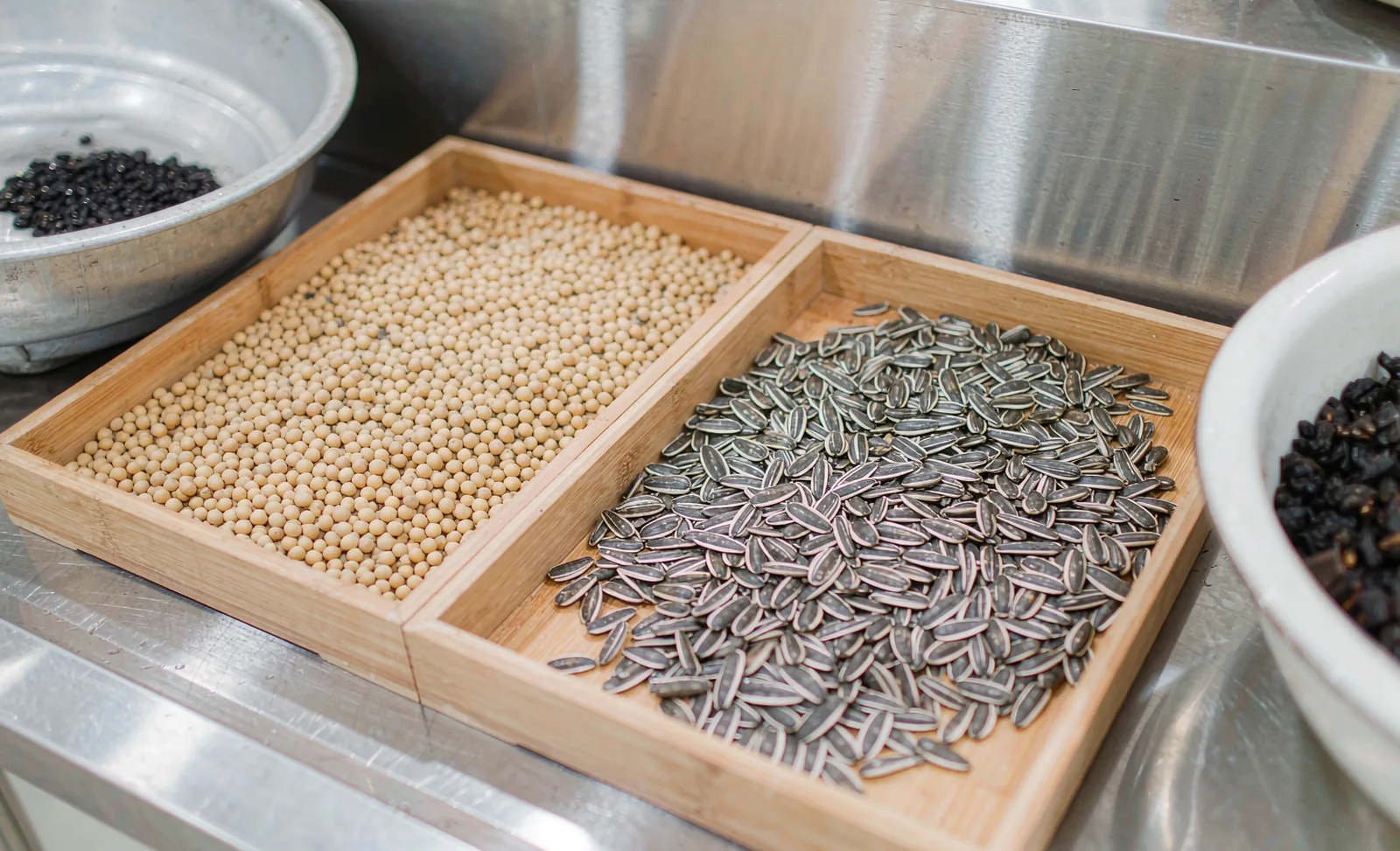
Commercial PS starts from either soybean lecithin or sunflower lecithin. Both follow the same route: the lecithin is fractionated, then enzymatically converted — typically via phospholipase D-mediated transphosphatidylation — replacing the choline head group with L-serine to yield PS. What changes is the raw material.
Soy lecithin is a byproduct of soybean oil crushing: abundant, globally traded, and inexpensive, with year-round availability. Sunflower lecithin comes from a narrower agricultural base concentrated in Eastern Europe, Argentina, and parts of France and Spain. The substrate determines the fatty acid carrier profile on your finished-product spec, the allergen status, and the identity documentation your QA team will review.
Non-GMO positioning is also easier with sunflower PS, since sunflower lecithin is predominantly non-GMO by origin, while soy programs need identity-preserved (IP) non-GMO soybeans and a documented IP chain to pass retail audits.
Allergen Labeling: The Soy Question in the US and EU
Under the US Food Allergen Labeling and Consumer Protection Act, soy is a major allergen that must be declared on supplement labels — typically as "contains soy." There is no de minimis threshold; presence triggers declaration. Sunflower is not a major allergen in the US or EU, so sunflower-derived PS carries no mandatory allergen statement. In the EU, Regulation (EU) No 1169/2011 Annex II lists soybeans among the 14 mandatory allergens; sunflower is absent — the same origin choice satisfies both regimes.
Two practical notes for QA directors. First, a "soy-free" claim on a sunflower-PS product needs the manufacturer's allergen control documentation, not just ingredient origin — cross-contact in the blending or encapsulation facility is a separate risk. Second, large US club and natural-channel retailers often audit allergen validation files during onboarding, so obtain the supplier's allergen statement and cleaning validation summary before finalizing label artwork.
Specification Differences Between Soy and Sunflower PS
Both origins are sold to similar assay targets — commonly 20%, 50%, or 70% PS by HPLC, in powder or oil/paste forms. In practice, several spec-line differences recur:
- Fatty acid profile: Sunflower lecithin is richer in linoleic acid (C18:2), which shows up in the fatty acid annex and can influence oxidative stability targets such as peroxide value limits.
- Color and odor: Soy-derived PS powder tends toward deeper yellow-beige; sunflower PS is lighter with a milder flavor — an advantage in capsules, powders, and functional foods.
- Minor phospholipid composition: The proportions of phosphatidylcholine, phosphatidylethanolamine, and phosphatidylinositol differ with the substrate — relevant when matching a reference formulation.
- Residual solvents: Fractionation may use ethanol or hexane depending on the manufacturer; confirm declared process aids match your destination-market limits, particularly for EU consignments.
Supply Chain Considerations and Regional Availability
Soy lecithin offers the deepest phospholipid raw material pool in the world — multiple crushing origins, liquid markets, easy re-sourcing on short notice. Sunflower lecithin depends on a narrower base with real year-to-year variation; buyers who lived through the 2022–2023 sunflower supply disruption will remember how quickly lead times and spot prices moved.
Practical consequences: sunflower PS programs benefit from dual-sourcing across at least two manufacturers and locking annual volumes rather than buying spot. Soy PS programs are easier to re-source but carry their own risk axis — GMO status documentation and soybean origin traceability, increasingly relevant for EU-bound consignments under deforestation due-diligence expectations. Lead times differ too: standard soy PS grades are commonly available from stock, while higher-assay sunflower PS (50–70%) is more frequently made to order.
Price Dynamics: What Buyers Actually Pay
As a rule of thumb, sunflower-derived PS commands a premium of roughly 15–30% over soy at the same assay level, though the spread varies with crop cycles, freight, and grade. The premium reflects the narrower raw material base. Price drivers to track:
- Underlying lecithin markets: Soy pricing tracks soybean crush economics; sunflower tracks seed availability. A bad sunflower harvest moves your quote even if the conversion process is unchanged.
- Assay grade and form: Compare offers on cost per kilogram of actual PS, not per kilogram of powder — a 70% grade costs far more than 20% at the same PS content.
- Volume and contract terms: Annual commitments and 6–12 month fixed-price windows compress the sunflower premium more than the soy premium, because suppliers gain planning certainty for a tighter raw material pool.
- Documentation scope: Non-GMO IP chains, allergen-free facility statements, and EU-compliant dossiers add cost on both origins, bundled differently per supplier.
Normalize for these before concluding one origin is "cheaper" — a lower headline price on soy PS can be offset by allergen-segregated handling, dedicated line time at your contract manufacturer, and "contains soy" artwork constraints on every SKU.
How Buyers Choose: A Decision Framework
A defensible origin decision resolves to four questions:
- Does the label position tolerate a soy declaration? If brand promise, retail program, or competitive set demands soy-free, sunflower is the default despite the premium.
- Which market regimes apply? US-only programs tolerate soy more easily; EU programs face Annex II declaration plus growing due-diligence expectations on soy origin.
- What is the margin sensitivity? Model landed cost per serving including allergen handling, artwork, and segregation — not just ingredient price per kilogram.
- How resilient must supply be? For large or growing volumes, qualify a backup origin — a soy-based contingency even when sunflower is primary, or vice versa.
For premium-positioned cognitive-health brands in the US and EU, sunflower PS has become the default despite the cost premium. For price-led private label where the allergen declaration is acceptable, soy remains the workhorse. Document the rationale either way — origin is one of the first questions auditors and retail QA reviewers ask.
FAQ
Q1: Is sunflower-derived PS nutritionally equivalent to soy-derived PS?
The phosphatidylserine molecule is chemically identical; origin changes the fatty acid carriers and minor phospholipid profile, not the PS assay. Published studies have used both origins, so the question is primarily about labeling and positioning, not activity.
Q2: Does soy-derived PS always require a "contains soy" statement in the US?
Yes. Soy is a major allergen under FALCPA, and products containing soy-derived PS must declare it. Highly refined lecithin exemptions from some food categories do not automatically carry over to supplement labeling — confirm with regulatory counsel.
Q3: Why does sunflower PS cost more, and is the premium stable?
The premium reflects far less sunflower lecithin production than soy, and it fluctuates with crop cycles. Annual volume commitments and longer fixed-price windows narrow it by giving suppliers planning certainty.
Q4: Can I claim "soy-free" on a product made with sunflower PS?
Yes, supported by ingredient origin plus the manufacturer's allergen control program — but the claim is only as strong as your cross-contact evidence. Keep allergen segregation and cleaning validation records in your substantiation file.
Q5: Should buyers dual-source across origins?
For meaningful volumes, yes. A qualified backup origin protects against sunflower crop failures and soy market shocks alike — and provides negotiating leverage at annual review.
Conclusion
The soy-versus-sunflower fork shapes your label, cost structure, and supply risk for the life of the product. Sunflower PS buys allergen-free positioning and cleaner flavor at a premium driven by a thinner raw material base; soy PS delivers deeper supply and lower cost at the price of a mandatory soy declaration and GMO-adjacent documentation. Write the origin requirement, assay grade, form, documentation scope, and premium tolerance into your RFQ before you issue it. When you are ready to compare origins on real numbers, send us your target assay, form, and annual volume, and we will return side-by-side quotations with full documentation packs for both soy and sunflower phosphatidylserine.
Sources
- U.S. Food and Drug Administration — Food Allergies: https://www.fda.gov/food/food-labeling-nutrition/food-allergies
- eCFR — 21 CFR Part 101, Food Labeling (allergen declaration requirements): https://www.ecfr.gov/current/title-21/chapter-I/subchapter-B/part-101
- European Commission — Food Information to Consumers (Regulation (EU) No 1169/2011, Annex II allergens): https://food.ec.europa.eu/food-safety/food-information-consumers_en
- NIH Office of Dietary Supplements — Dietary Supplements background and regulatory context: https://ods.od.nih.gov/
- U.S. Food and Drug Administration — Dietary Supplements: https://www.fda.gov/food/dietary-supplements
Recommended next steps
- Review the Phosphatidylserine product page.
- Compare Soy PS and Sunflower PS.
- Check manufacturing proof and Quality & R&D.
Contact sales for product documents
Share source preference, application, country, and annual quantity.
Contact Sales