

A toll manufacturer's quotation shows a batch size, a toll fee and a lead time. It usually does not show a yield — and when it does, it is a single number with no denominator. That missing figure is where buyers lose money quietly. A toller charging per batch and yielding 82 percent of theoretical delivers 18 percent less material for the same fee; a toller charging per delivered kilogram simply raises the unit price.
Yield and mass balance make the rest of the arrangement checkable. Mass balance asks whether the books close: does material in equal material out plus accounted loss? Yield asks how efficiently the process converted input into saleable output, turning a toll relationship into something a buyer can verify with arithmetic rather than trust.
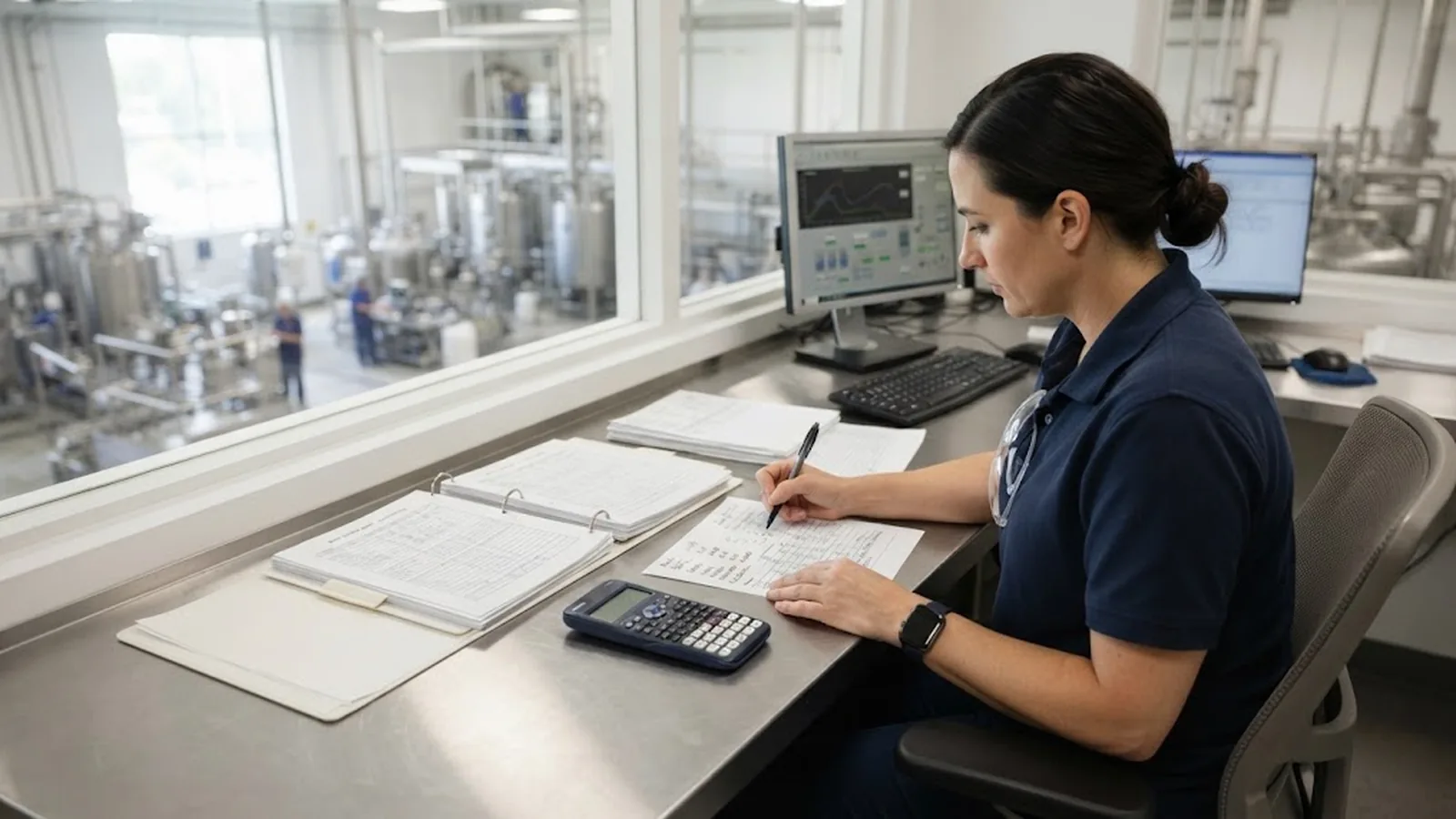
!Process engineer reviewing batch record sheets and yield reconciliation tables at a control desk in an ingredient manufacturing plant For non-GMO and European programmes, our sunflower phosphatidylserine page covers the specification and documentation set buyers typically request.
What Mass Balance Proves — and What It Does Not
A closed mass balance states that everything charged to the process is either in the finished lot, in a recoverable side stream, in a retained sample, or in an accounted loss. It is a bookkeeping discipline, and it is powerful precisely because it is boring: it catches material that went somewhere nobody wrote down.
What it does not prove is quality. A batch can close perfectly on mass and still fail on assay or particle size, because mass balance says nothing about whether material was degraded rather than lost. Nor does it prove the input was what the certificate claimed: a supplier can charge a low-assay lot and deliver a correctly sized drum, and the balance will close while the potency is short. That is why mass balance should be paired with assay reconciliation — the same arithmetic applied to phosphatidylserine content rather than to weight.
The Reconciliation Arithmetic and the Two Yields
Ask for the numbers in this order, because each one constrains the next. Charged input: the mass and assay of every lot charged, including recycled or reworked material, by lot number. Theoretical output: charged mass multiplied by assay, divided by target specification content, giving the expected saleable mass at spec. Actual saleable output: packed and released material at confirmed assay. Side streams and recoverables: material downgraded, held for rework or returned to a previous step — this must be valued, not written off as "loss". Unrecoverable loss: the difference, itemised by process step rather than presented as one balancing figure. Retained samples: a small line that still belongs in the reconciliation, because draws of a few hundred grams per batch become material across a hundred batches.
Mass yield is output mass divided by input mass. Active yield is output activity divided by input activity — kilograms of PS on an assay basis, the number that drives your label claim and dosing cost. A toller reporting 95 percent mass yield and 88 percent active yield is saying something specific: material survived, potency did not.
Where Phospholipid Yield Actually Disappears
Phospholipid processing has a characteristic loss profile that a manufacturer should be able to map step by step.
- Filtration. Filter media retain product, especially in the first litres of a cycle, and that mass is rarely recovered unless the filter is washed and the wash returned.
- Phase separation. Aqueous and solvent phases do not split cleanly at the interface; the rag layer and the vessel heel are real losses if the equipment cannot be drained fully.
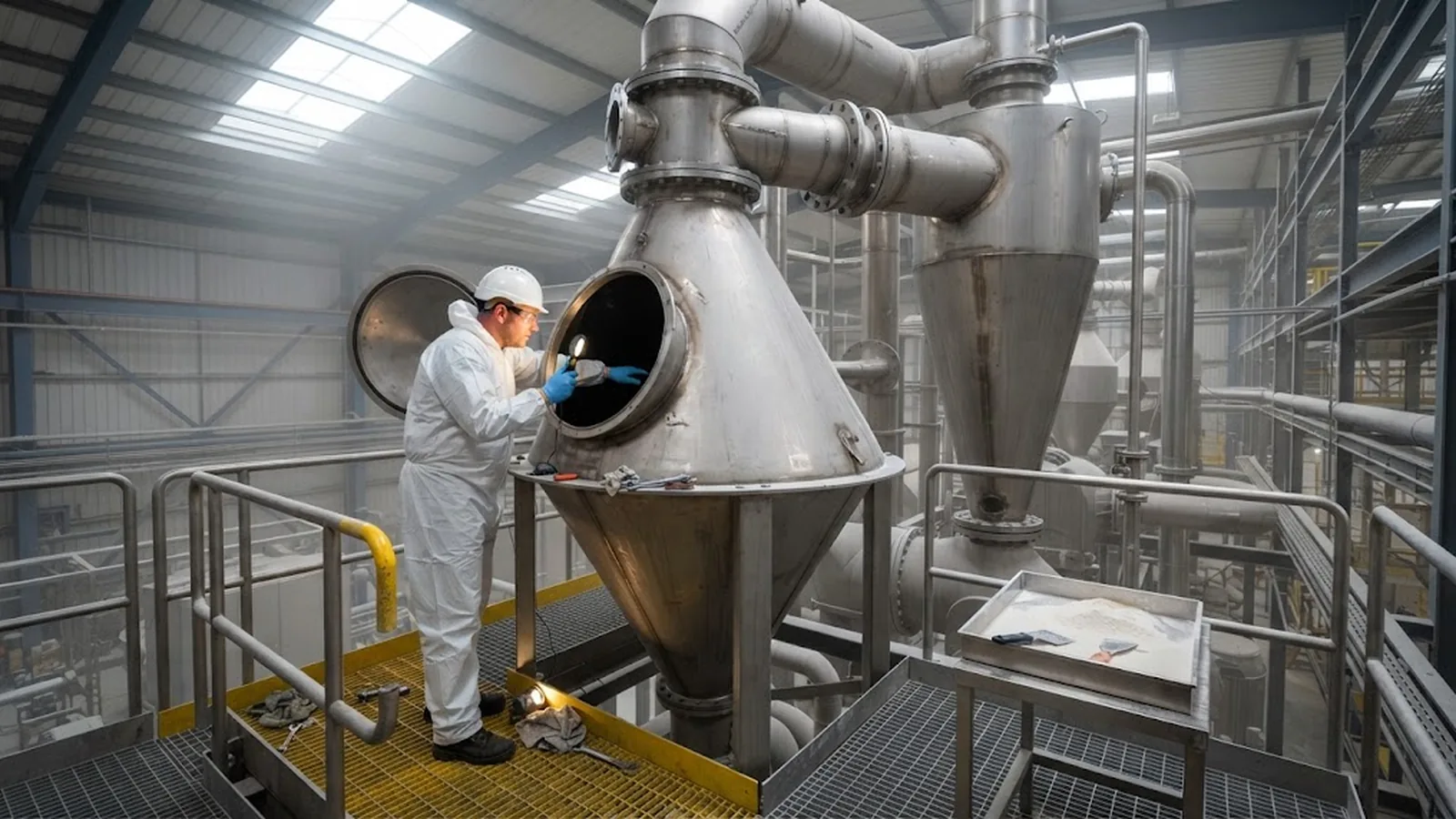
- Dryer hold-up. Spray, tray and vacuum dryers retain material on walls, in cyclones and in ductwork. A dryer cleaned monthly rather than per campaign returns that material to a mixed side stream at best.
- Sieving and milling. Oversize material rejected at the screen is a candidate for re-milling, not write-off — but only if the record shows it was reworked rather than discarded silently.
- Packaging residues. In-process draws, the last kilogram in a hopper and powder adhering to liner walls are genuine losses that scale with the number of packs per batch.
A useful audit question is simply: "Show me the last ten batches and tell me which step produced the largest loss in each." A manufacturer that can answer has a loss model. One that cannot usually has a single unexplained balancing number, which is where misrecording hides.
Reading the Batch Record and Charting Yield Drift
Most yield problems are visible in the batch record before any laboratory work. Check six fields: charged versus issued quantities; rework entries, which should carry their own lot number, assay and mass; the yield calculation basis, since as-is and assay-corrected figures are not comparable; the sample log matched against analytical requests; deviation notes, because an unexplained excursion with no deviation record has usually been normalised rather than investigated; and the sign-off sequence, since a reconciliation signed only by production is a production target, not an objective record.
A single yield figure is uninformative; a control chart of active yield across 20 to 30 consecutive batches is a diagnostic instrument. A gradual decline points to equipment condition — a fouling filter, a worn screen, a dryer losing efficiency — and usually precedes a customer-visible quality excursion. A sudden step change points to an unnotified change in input material, operator practice or process. Increased scatter points to reduced process control. State in the quality agreement that yield data is supplied batch by batch rather than as a monthly summary, because summaries hide the variability you are looking for.
Contracting Yield, Auditing Claims and the Notification Threshold
Three commercial structures are common, and each shifts risk differently. A per-batch fee with no yield term leaves process-efficiency risk with the buyer. A per-kilogram fee with a minimum yield guarantee puts that risk on the manufacturer above the guaranteed level and on the buyer below it — the structure most buyers want, provided the guarantee is defined on an assay-corrected basis and the measurement method is named. A yield-share arrangement splits the value of yield above an agreed baseline, which aligns incentives but depends on a trusted measurement system.
Whichever structure you choose, settle four things in writing: the yield basis and the test method that establishes it; responsibility for raw material losses caused by the manufacturer's process versus those inherent to the input; ownership and disposition of off-spec and downgraded material; and the treatment of rework, so recycled material is neither double-counted in the buyer's favour nor quietly omitted. The clause that most often goes missing is the notification threshold — define the excursion level at which the manufacturer must notify you and open a deviation, rather than reporting it in the next monthly summary.
To audit claims without re-running a batch, bring the batch records for a defined period, the corresponding CoAs, and your own purchase and receipt records, then reconcile them lot by lot. The receipt record is the independent anchor — the only numbers the manufacturer did not write. Then probe the edges: where the wash and rinse streams went, how the previous campaign's filter cake or cyclone catch was classified, and the reconciliation for a batch that yielded notably high rather than at target, because an unusually high yield is as diagnostic as a low one.
FAQ
Q: What is the difference between mass yield and active yield for phosphatidylserine?
A: Mass yield is saleable output weight divided by input weight. Active yield is the same ratio calculated on PS content, using assays for both the input lots and the finished material. Active yield is the commercially meaningful figure because it drives label claim and dosing cost; a gap between the two indicates potency loss rather than material loss.
Q: What is a reasonable yield to expect from a phosphatidylserine toll manufacturer?
A: Yields vary widely with process route, batch size and equipment, so there is no universal benchmark. What matters is that the manufacturer can itemise its losses by process step and show a stable, controlled yield range across a run of batches. Ask for 20 to 30 consecutive batches of assay-corrected data, not one quoted figure.
Q: Should a toll manufacturing agreement include a yield guarantee?
A: If you pay per batch or per kilogram on a fixed conversion basis, yes — but only if the clause names the yield basis (assay-corrected), the analytical method, and the response when the guarantee is missed. Without those three elements it is difficult to enforce.
Q: How can I tell whether an unexplained yield loss is normal process loss or something else?
A: Ask for an itemised loss breakdown by process step rather than a single balancing figure. Losses that recur at the same step are process characteristics; losses that appear as an unassigned residue, or that move between steps across batches, justify a targeted audit of store issues, rework entries and side-stream disposition.
Conclusion
Yield is the one part of a toll manufacturing quotation a buyer can verify rather than accept. Ask for the reconciliation in full form — charged input by lot and assay, theoretical and actual output, valued side streams, step-by-step losses and sample draws — and check it against an independent record. Chart active yield across a run of batches so drift shows up before a shortage does. Then contract the yield basis, the notification threshold and the disposition of off-spec material, so the number in the monthly report is a measurement rather than a negotiation. When you are ready to move from checklist to quotation, contact our team with the grade, source and document set described above.
Sources
- U.S. Electronic Code of Federal Regulations — 21 CFR Part 117, Current Good Manufacturing Practice, Hazard Analysis, and Risk-Based Preventive Controls for Human Food: https://www.ecfr.gov/current/title-21/chapter-I/subchapter-B/part-117
- U.S. Food and Drug Administration — Guidance for Industry: Process Validation: General Principles and Practices: https://www.fda.gov/regulatory-information/search-fda-guidance-documents/process-validation-general-principles-and-practices
- U.S. Electronic Code of Federal Regulations — 21 CFR Part 111, Current Good Manufacturing Practice in Manufacturing, Packaging, Labeling, or Holding Operations for Dietary Supplements: https://www.ecfr.gov/current/title-21/chapter-I/subchapter-B/part-111
- FAO / WHO Codex Alimentarius — General Principles of Food Hygiene: https://www.fao.org/fao-who-codexalimentarius/codex-texts/codes-of-practice/en
- ISO — ISO 9001 quality management systems: https://www.iso.org/iso-9001-quality-management.html
Buyer fit
Who this guide is for
This guide is written for the buyer profiles below. Open your profile for the matching grades, documents and next steps, or tell us your requirements directly.
Recommended next steps
- Review the Phosphatidylserine product page.
- Compare Soy PS and Sunflower PS.
- Check manufacturing proof and Quality & R&D.
Contact sales for product documents
Share source preference, application, country, and annual quantity.
Contact Sales