
Trade show season compresses a year of supplier discovery into three or four days. For a procurement or quality manager sourcing phosphatidylserine, that means a chance to meet more PS producers, traders, and contract manufacturers in one hall than you could reach in six months of email. It also means a risk: without a plan, the days fill with brochures, samples of unrelated products, and conversations that go nowhere.
The buyers who get real value from ingredient expos treat them as a structured qualification stage, not a networking event. Before the doors open, they know which PS suppliers they need to meet, what documents to request, and what answers will move a supplier onto — or off of — the shortlist. This guide walks through that process from a US/EU buyer's perspective: building the target list, running effective meetings, and converting show-floor conversations into qualified phosphatidylserine supply.
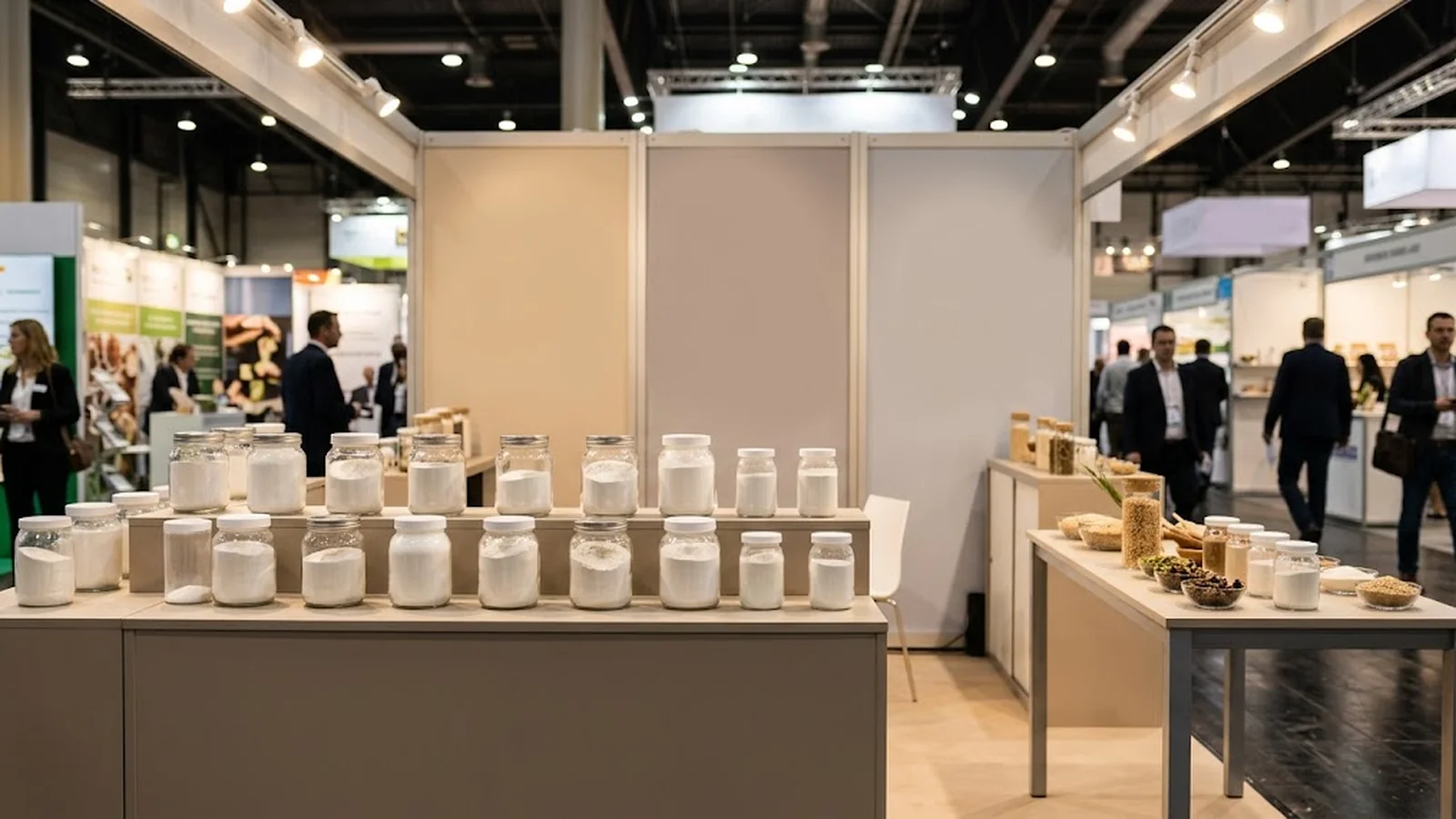
!Phosphatidylserine ingredient supplier exhibition booth at a trade show Where supplier qualification is the next step, our manufacturing overview documents the facility, process controls and batch records behind each lot.
The sections below cover preparation, execution, and follow-up for PS supplier meetings at ingredient expositions.
Why Trade Shows Still Matter for Phosphatidylserine Sourcing
Email and video calls are efficient, but they hide things. A trade show lets you stand across the table from the person who will actually handle your phosphatidylserine account, watch how they answer technical questions, and compare their claims against those of their competitors in the same hall. For an ingredient like PS — where soy-derived and sunflower-derived powders, different assay methods, and varying documentation standards all coexist — that direct comparison is hard to replicate remotely.
Expos are also where new supply options appear first. Manufacturers launching a sunflower PS line, a new granulation, or an oil-based delivery form often time the announcement to Vitafoods Europe or SupplySide West. A buyer who walks the floor with a clear brief will hear about these options months before they surface in search results or supplier directories.
Finally, meetings at shows accelerate the paperwork. A supplier who meets you in person and sees a serious procurement process behind your questions is far more likely to release specifications, certificates of analysis, and audit summaries quickly after the event.
Pre-Show Research: Building a Target Supplier List
Start four to six weeks before the show. Pull the exhibitor list and search it for every company plausibly connected to phosphatidylserine: ingredient manufacturers, their regional distributors, and contract manufacturers who list nootropics or cognitive-health formulations. Classify each contact as manufacturer, trader/distributor, or unknown, because this classification shapes what you ask for later.
For each priority target, prepare a one-page brief covering: the PS grade and source you need (soy or sunflower, powder or liquid, typical assay specification), your approximate annual volume, target markets, and the documents your quality system requires — specification sheet, CoA, allergen and GMO statements, food safety certification scope, and regulatory support letters. Booking meetings in advance through the show's appointment system beats hoping to catch someone at a busy booth; most exhibitors reserve their senior technical staff for scheduled appointments.
Set a realistic quota. Three or four well-prepared PS meetings per day is more productive than ten rushed ones. Leave gaps for the unplanned conversations that are often the most valuable.
Questions That Separate Manufacturers from Traders
On the show floor, everyone sounds like a manufacturer. A few precise questions reveal who actually controls the supply:
- "Which plant produces this PS, and is that facility listed on your food safety certificate?" A manufacturer answers with a site name and certification body; a trader hesitates or pivots to their product range.
- "Is the phosphatidylserine enzymatically derived from lecithin at your own facility or a partner's?" PS is produced from phosphatidylcholine-rich lecithin by enzyme conversion; knowing where that step happens tells you who controls process changes and change notification.
- "What is your current source of lecithin — soy or sunflower — and have you changed it in the last 24 months?" Source changes affect allergen labeling and, in the EU, sunflower supply reliability questions.
- "What assay method do you use to declare PS content, and can the CoA show it?" Different methods report different numbers on nominally identical material.
Write the answers down immediately. Memory fails by day two of a show, and the written record becomes the baseline for document verification later.

Document Requests and Follow-Up Discipline After the Show
Ask for documents during the meeting, not afterward. Any supplier can promise "we will send everything next week"; a supplier who hands you a specification sheet and a sample CoA at the booth, or sends them within 48 hours of your request while the show is still running, is demonstrating the responsiveness you will need during an actual order.
Your post-show pack for each PS supplier should include: the full specification sheet, a recent CoA with assay results, food safety certification (FSSC 22000, ISO 22000, or B) scope covering the production site, allergen, GMO, and irradiation statements, and any regulatory letters relevant to your market — GRAS status or NDI discussions for the US, novel food context for the EU. Match every document against what was said at the meeting. Discrepancies between a verbal claim ("sunflower sourced, non-GMO") and the written statement are exactly what your follow-up should catch.
Send your consolidated follow-up within one week, while the supplier still remembers you. Prioritize requests, attach your RFQ template if one already exists, and state your timeline. A buyer who follows up fast and precisely is queued ahead of the hundreds of contacts the supplier collected.
Red Flags to Watch on the Show Floor
Some signals deserve caution. A booth that will not name a production site or certification body. Marketing claims of "pharmaceutical grade" with no specification to back it. Prices far below the market range for PS, which usually mean diluted or misdeclared material. Samples of "your product" that are clearly a generic powder blend. And a sales team that cannot answer basic assay or source questions without checking with someone who is not present — acceptable once, worrying as a pattern.
None of these flags is a final verdict, but each one should raise the level of documentation and verification you demand before moving to samples and site audit.
FAQ
Q: How early should I book meetings with phosphatidylserine suppliers before a trade show?
A: Two to four weeks ahead is ideal. Major PS exhibitors fill their schedules with scheduled appointments, and senior technical or regulatory staff — the people who can discuss assay methods and documentation — are usually reserved first. Booking early through the show's appointment system also signals that you are a serious procurement contact.
Q: Should I request samples at the show itself?
A: You can accept a booth sample for a quick identity check, but formal sampling should follow your own procedure. Ask the supplier to arrange batch samples with a corresponding CoA after the show, so the material you evaluate is traceable and representative rather than an anonymous pouch from a display counter.
Q: How do I handle distributors at the show if I prefer to buy from the manufacturer?
A: Meet them anyway, briefly. Distributors can tell you who the actual manufacturer is, how responsive that manufacturer is, and what service levels look like in your region. If you later approach the manufacturer directly, the distributor relationship may still be the practical route for smaller volumes or local stock.
Q: What single deliverable matters most from a PS trade show meeting?
A: A site-specific specification sheet paired with a recent CoA. Together they let your quality team start real evaluation — assay method, source, tolerances, and certifications — before the next conversation. Everything else at a trade show is positioning; these two documents are verification.
Conclusion
Trade shows reward preparation more than charisma. A buyer who arrives with a classified target list, a question set that exposes the real supply chain behind phosphatidylserine offers, and a follow-up process that converts conversations into documents will leave the hall with qualified candidates rather than a bag of brochures. Treat the show as the first stage of supplier qualification, hold every verbal claim against written evidence afterward, and the exhibition budget becomes one of the most efficient line items in your sourcing program. For help assembling the document pack from any supplier you meet, the Nutranexa team supports US and EU buyers with full specification and regulatory documentation for PS ingredients. When you are ready to move from checklist to quotation, contact our team with the grade, source and document set described above.
Sources
- FDA — Dietary Supplements: https://www.fda.gov/food/dietary-supplements
- EFSA — Nutrition and health claims: https://www.efsa.europa.eu/en/topics/topic/nutrition-and-health-claims
- PubMed — Phosphatidylserine review literature: https://pubmed.ncbi.nlm.nih.gov
- SupplySide West: https://www.supplysideshow.com
- Vitafoods Europe: https://www.vitafoods.eu
- IFS / FSSC certification context: https://www.foodsafety.directory
Buyer fit
Who this guide is for
This guide is written for the buyer profiles below. Open your profile for the matching grades, documents and next steps, or tell us your requirements directly.
Recommended next steps
- Review the Phosphatidylserine product page.
- Compare Soy PS and Sunflower PS.
- Check manufacturing proof and Quality & R&D.
Contact sales for product documents
Share source preference, application, country, and annual quantity.
Contact Sales